




 Why Trust Us?
ToProxyLab has been testing proxy services since 2025. We pay for most plans ourselves, and when a provider gives us test traffic we say so in the review — free traffic buys a place in the testing queue, nothing else. Every provider goes through the same speed, uptime and fraud-score checks, and we publish the real numbers, including the bad ones. A rating cannot be bought. Learn who we are and how we review proxies.
Why Trust Us?
ToProxyLab has been testing proxy services since 2025. We pay for most plans ourselves, and when a provider gives us test traffic we say so in the review — free traffic buys a place in the testing queue, nothing else. Every provider goes through the same speed, uptime and fraud-score checks, and we publish the real numbers, including the bad ones. A rating cannot be bought. Learn who we are and how we review proxies.
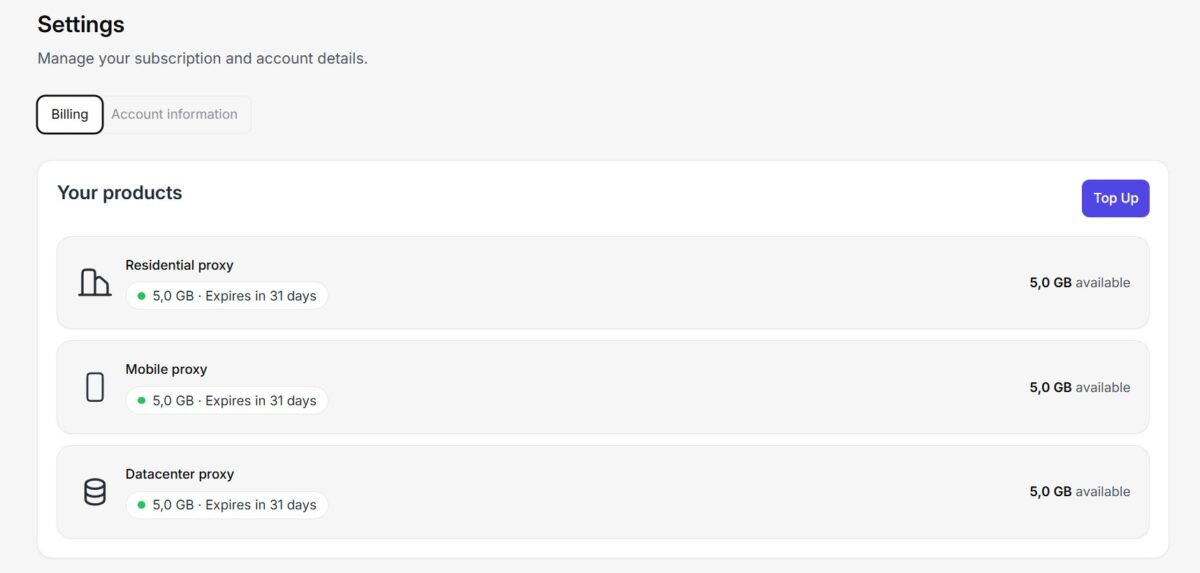
Quick backstory. A floppydata.com rep slid into my DMs and offered me a chance to test their proxies for an independent review. I said yes — happened to be looking for a decent provider for Reddit account work anyway. Honest deal: they credit me 15 GB of test traffic (5 GB each for residential, mobile, and datacenter), and I run random IPs through every checker service I know of and write up what I find. No editorial control on their end.
Upfront caveat. For a clean experiment I only used residential proxies and only the US location, Houston. Why the US — I’ll get to that, there’s a whole stack of reasons. Mobile and datacenter are still sitting untouched on my balance, might come back to them in a separate piece.
Why the US specifically and who actually needs this
Simple. Most of the big platforms — Facebook, Instagram, X, TikTok, Google, Amazon, eBay, PayPal, Netflix — are American. Their antifraud is calibrated for a US audience from the get-go. An American IP gets the maximum trust credit, triggers captcha less often, gets shadowbanned less. Plus the States have a massive pool of clean residential addresses and mature ISP infrastructure.
Who needs this for work. SMM folks and affiliate marketers — for multi-accounting on FB/IG/TikTok, warming up profiles, running ads to a solvent audience. Dropshippers — Amazon, eBay, Etsy, Shopify, Walmart either don’t let you in or cripple features without a US IP. Betting and gambling — DraftKings, FanDuel, BetMGM only work from inside the US. SEO specialists — checking Google SERPs in the US region, scraping Ahrefs/Semrush from American nodes. Crypto traders for Coinbase, Kraken, Robinhood. Sneaker resellers for Nike SNKRS and Supreme drops — without hundreds of unique US residential IPs you’ve got nothing to do there. HR people doing LinkedIn scraping. Streamers — Netflix US, Hulu, HBO Max, ESPN+.
And me — for Reddit. Subreddits sniff out ASN and fraud markers instantly, so you need an ISP at the level of Comcast, AT&T, Spectrum. Not datacenter.
First impressions of the dashboard
Logged in, activated the test balance — 15 GB total, 5 of each type. Lifespan 31 days. Billing is transparent, found it right away.
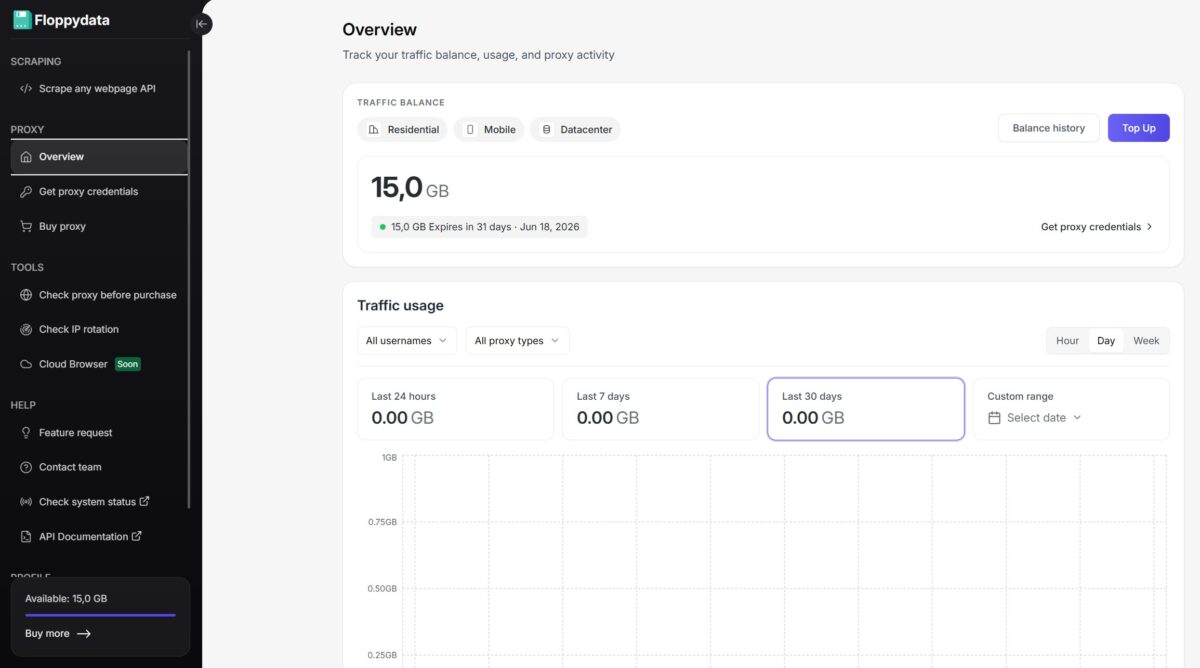
The interface is minimalist. Not GoLogin with its thousand tabs, but not a bare JSON config like some no-name providers either. Everything you need — credential generation, rotation check, pre-purchase site tester, docs — is in the side panel. There’s a “Cloud Browser — Soon” tag, looks like they’re cooking up their own antidetect. We’ll see.
One thing I liked. On the Get proxy credentials page you don’t just get a ready-made string and have to figure it out yourself — you build the config with a constructor. Country, state, city, ASN, rotation (from every request to 60 minutes), protocol, number of ports. And right there is a hint: “changing parameters generates new strings, but previously copied ones keep working.” Handy when you’re running a dozen different scenarios in parallel.
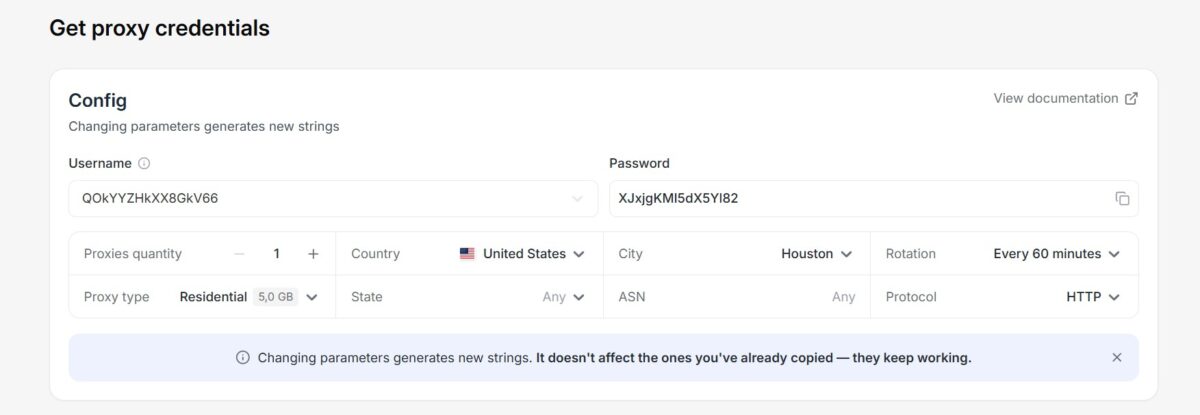
Test parameters
To keep things clean, I locked in strict parameters:
- 1 port, Residential type
- Country: US, city: Houston
- State: Any, ASN: Any
- Rotation: every 60 minutes (sticky session)
- Protocol: HTTP
- Host:
geo.g-w.info, port:10080
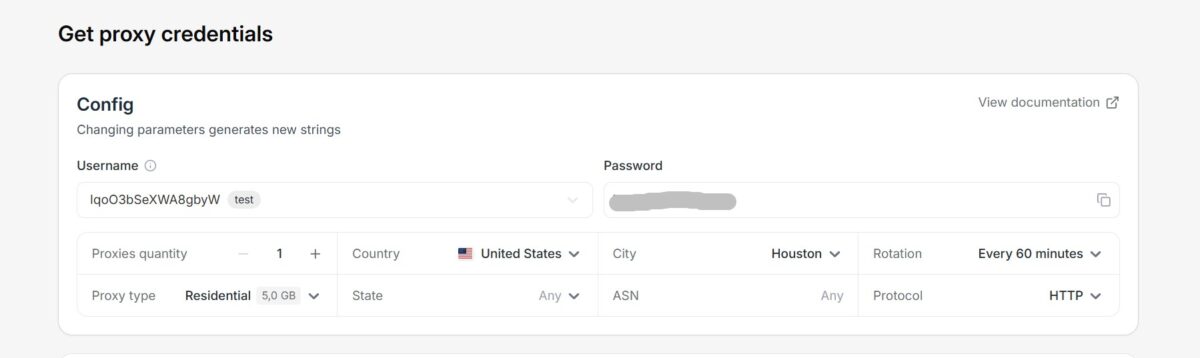
Generated the login/password with the tag “test” so I could pull separate stats for that username later.
Plugging it into the antidetect. Floppydata hands you a string in the format http://user-IqoO3bSeXWA8gbyW-type-residential-session-...-country-us-city-Houston-rotation-...@geo.g-w.info:10080. Session parameters are baked into the username — industry standard (Bright Data, Smartproxy, IPRoyal do the same). One proxy endpoint, a million configurations through the login.
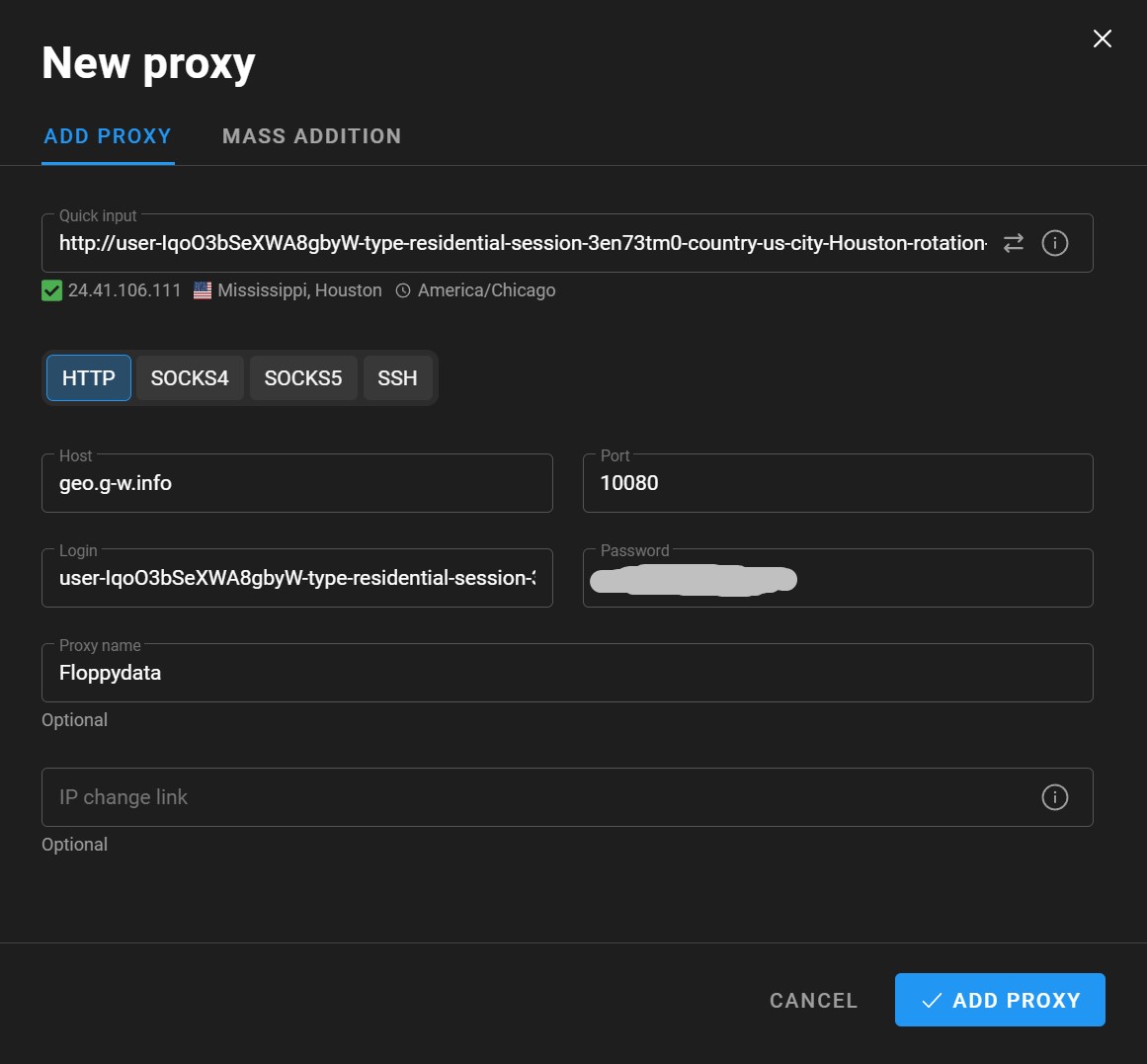
And here’s the first minor hiccup. I specified Houston in the config, and the quick-parser on the first connect showed Mississippi. OK, residential rotation works off a pool, sometimes it picks an IP “near” the city — that’s normal for every provider. After that, through the antidetect and online checkers, I consistently got Houston, Texas.
Test IP #1: 73.76.181.74
Grabbing the first IP, checking it everywhere I can.
Geolocation and ASN
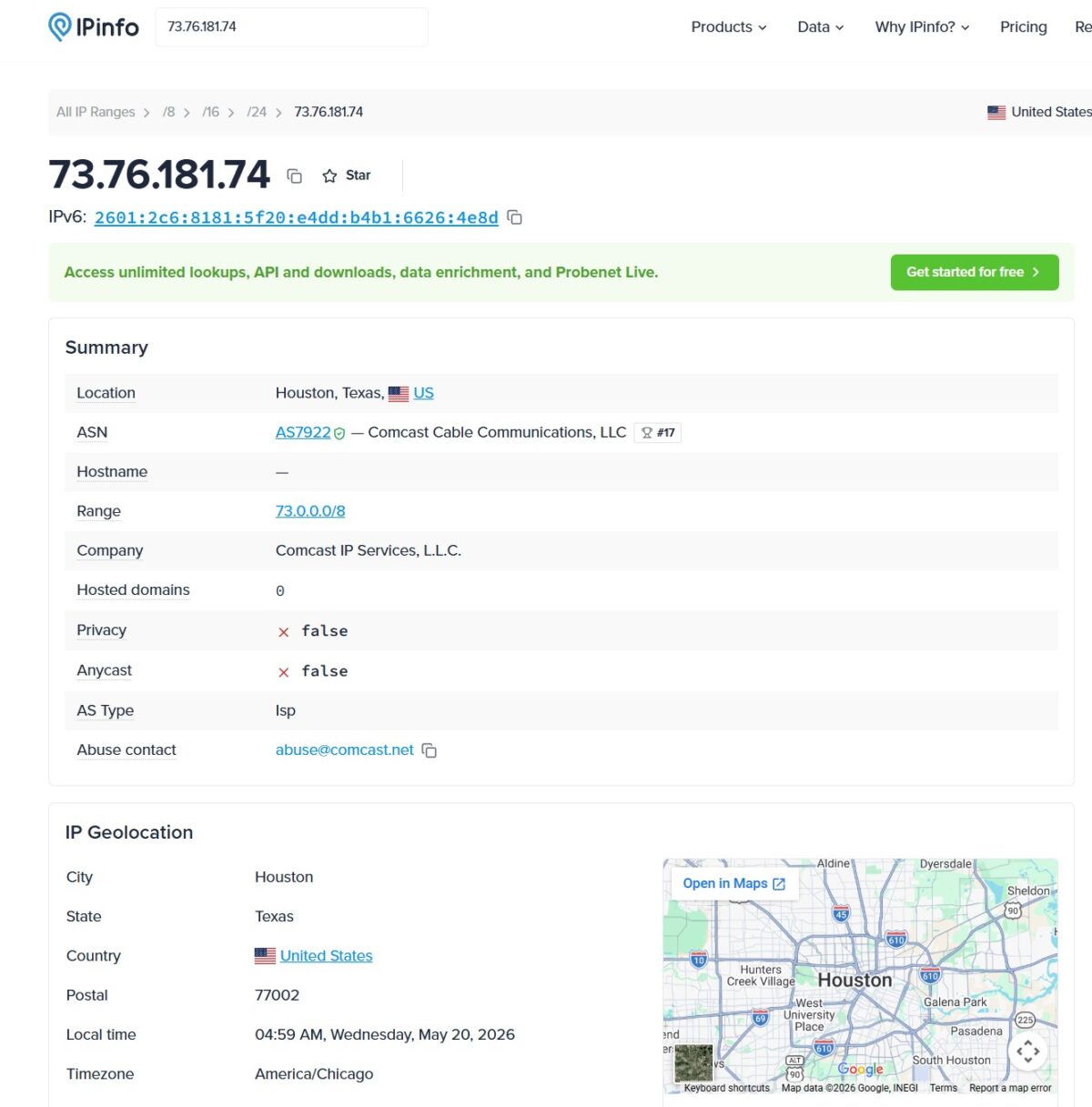
AS7922 is Comcast, one of the top-3 ISPs in the States. Per bgp.tools, the network peers with 244 others and has 8 upstreams — meaning this is a real backbone, not some tiny VPS host pretending to be residential. IPinfo flags AS7922 as a Top ISP in its ranking. For antifraud systems this is the ideal signal.
Fraud Score and detection
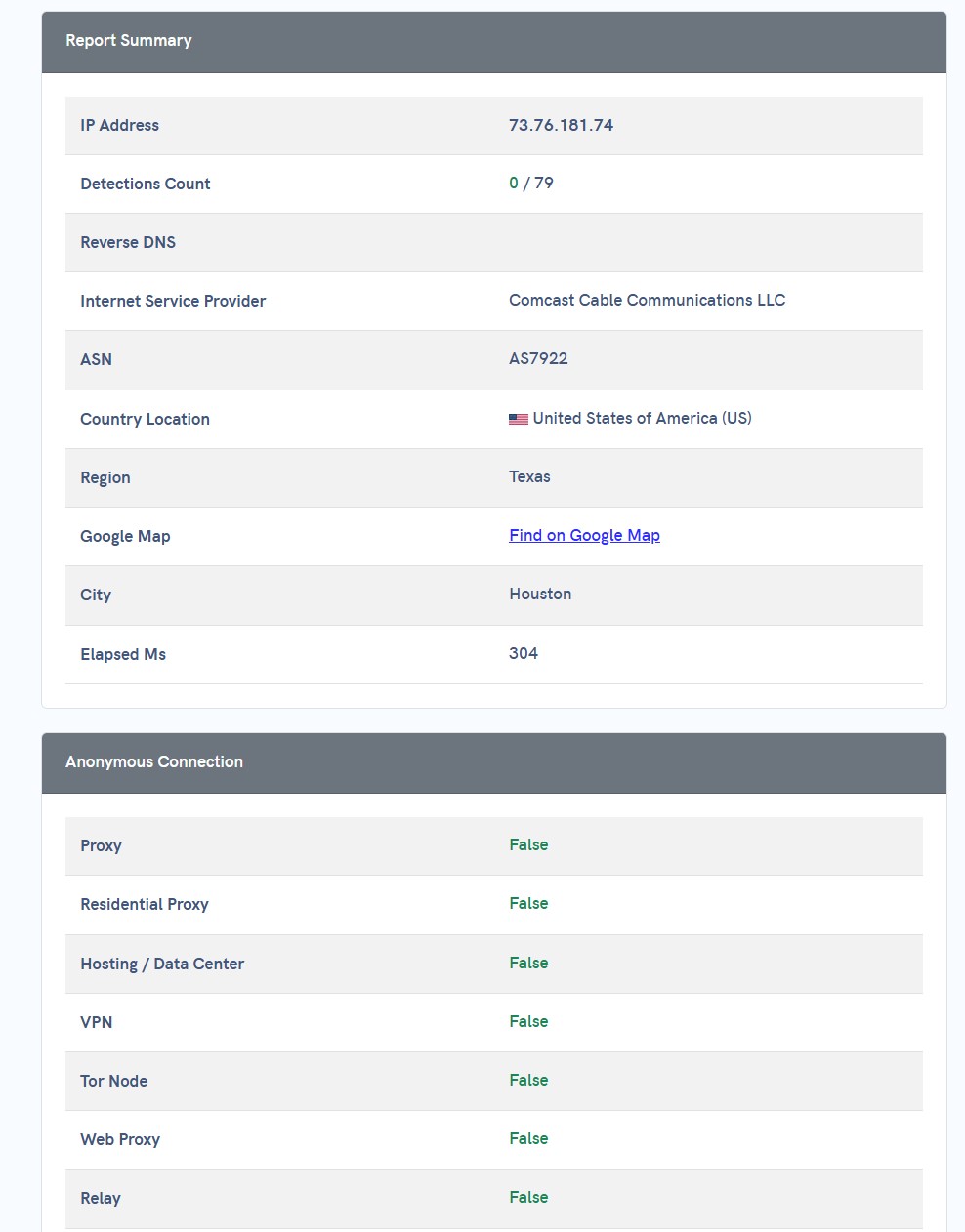
Zero detections out of 79 checks. Seriously. I’ve tested proxies from other providers — usually at least 2-3 flags pop up (residential proxy, public proxy, datacenter overlap). Here, clean.
DNS Leak
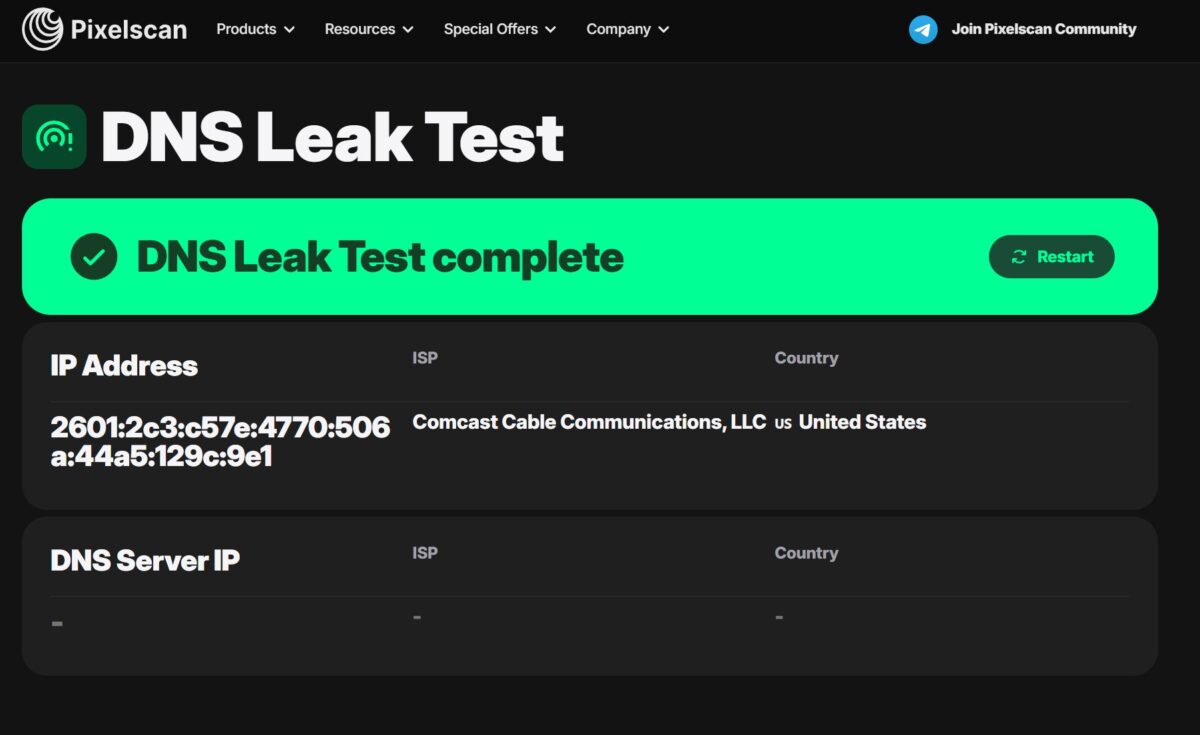
DNS resolves on the proxy side, the local resolver doesn’t show through. That’s a direct benefit of the SOCKS5 infrastructure with FQDN resolving support, but it works correctly for HTTP too.
Browser Fingerprint
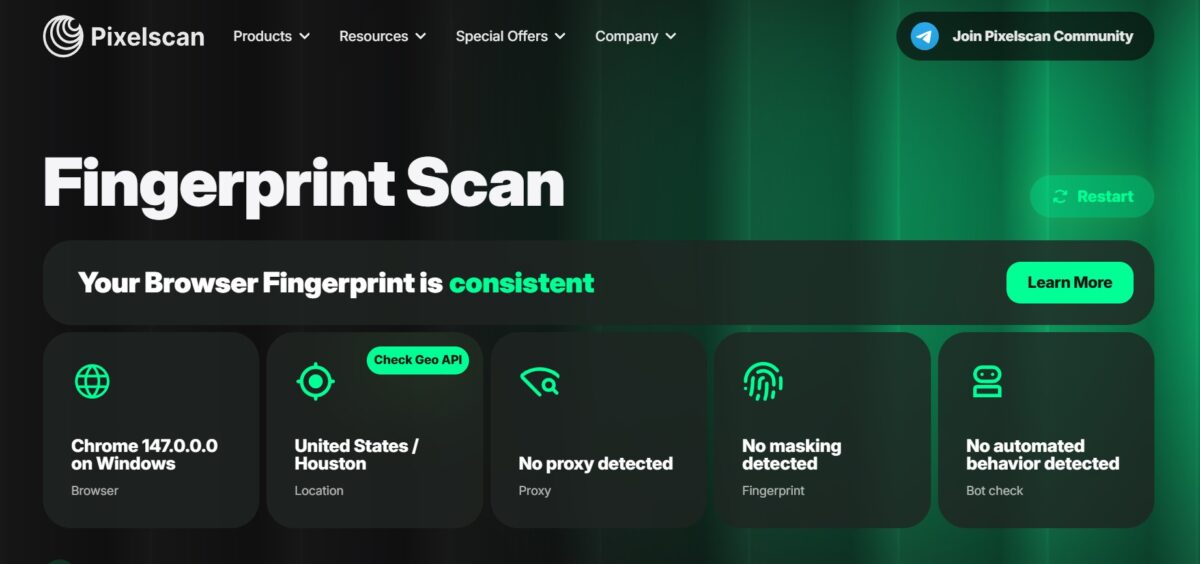
Full match between the fingerprint and the IP geo. Pixelscan didn’t find a proxy, didn’t find masking, didn’t find automation signs. For an antidetect this is the gold standard.
IP Change Detector (Floppydata’s own tool)
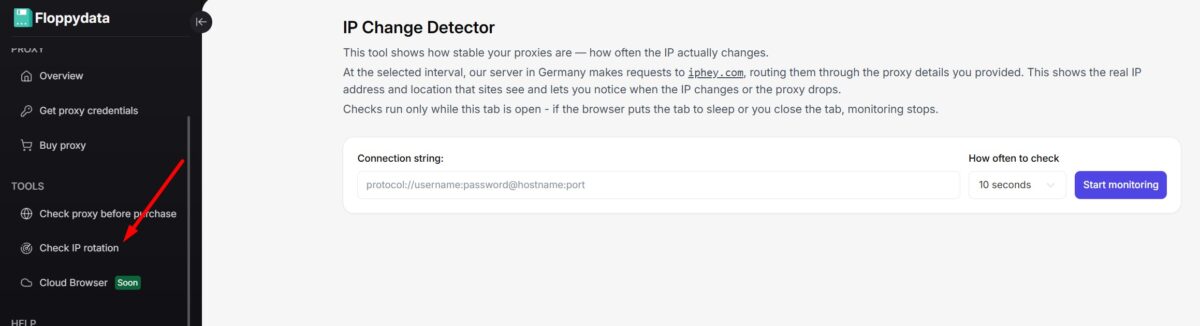
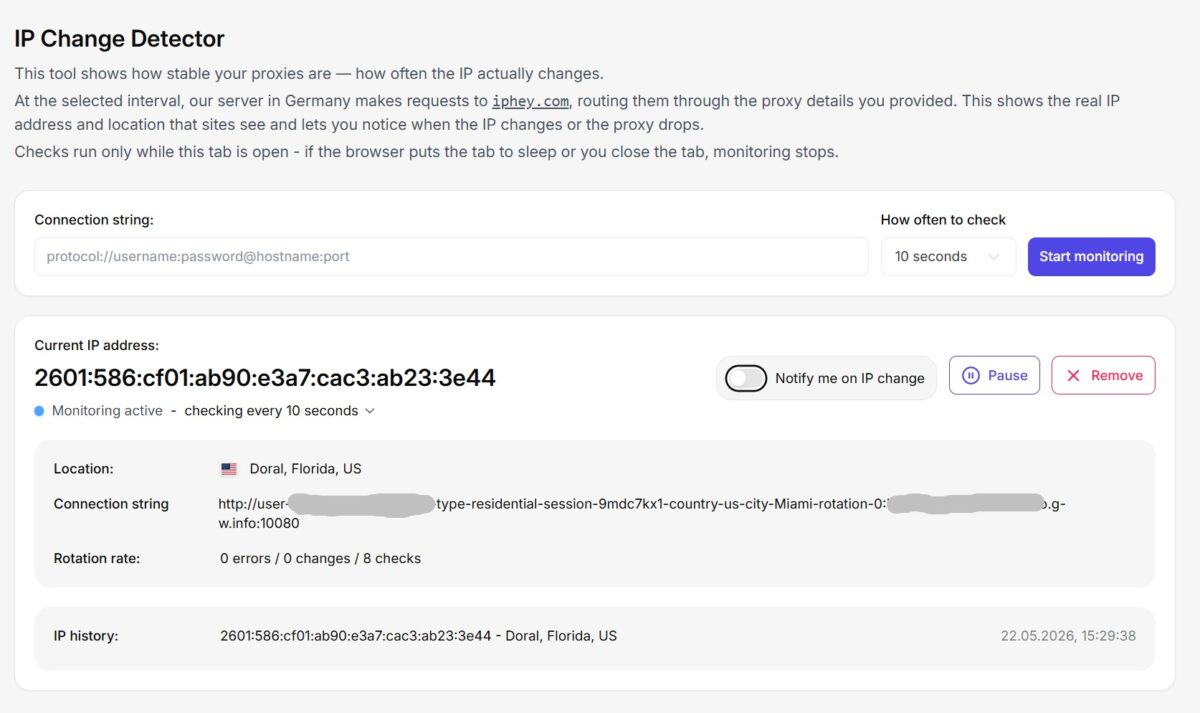
The dashboard has this built-in thing — Check IP rotation. A server in Germany pings iphey.com through your proxy at a set interval and logs how often the exit IP changes. Useful for verifying rotation honesty — making sure they’re not feeding you the same address for hours under the “rotating” label.

And here’s what makes reading reviews to the end worth it
After about 30 minutes of active testing, the proxy just dropped. Sites stopped responding in the antidetect, checkers timed out. I check the dashboard — balance is fine, the ticket on Floppydata’s side is technically active, but the port isn’t answering. Ping to geo.g-w.info goes through, the gateway accepts auth — the exit node is dead.
To not waste time arguing with support (I would’ve mentioned it in the review anyway), I did what any user would — generated new credentials with a different session ID and continued with a new IP. Took 15 seconds.
By the way, this is one reason I don’t buy the “100% uptime” claim from anyone on the market. Everyone has issues. The question is how fast you recover and whether there’s a quick reroute mechanism. Floppydata has one — swap the session token in the login, get a new exit in 15 seconds. The geo.g-w.info gateway architecture itself doesn’t take a hit — as they explain in their own blog, each protocol gets its own port: 10080 for HTTP, 10443 for HTTPS, and 10800 for SOCKS5. Session parameters (country, city, proxy type, rotation) go through a structured username — one endpoint, any combination via the login.
I didn’t bother screenshotting the repeat tests for the second IP. Same picture — clean Comcast, zero detections, normal speed. No point duplicating visuals.
Test IP #2: 76.31.104.92 (this one gets interesting)
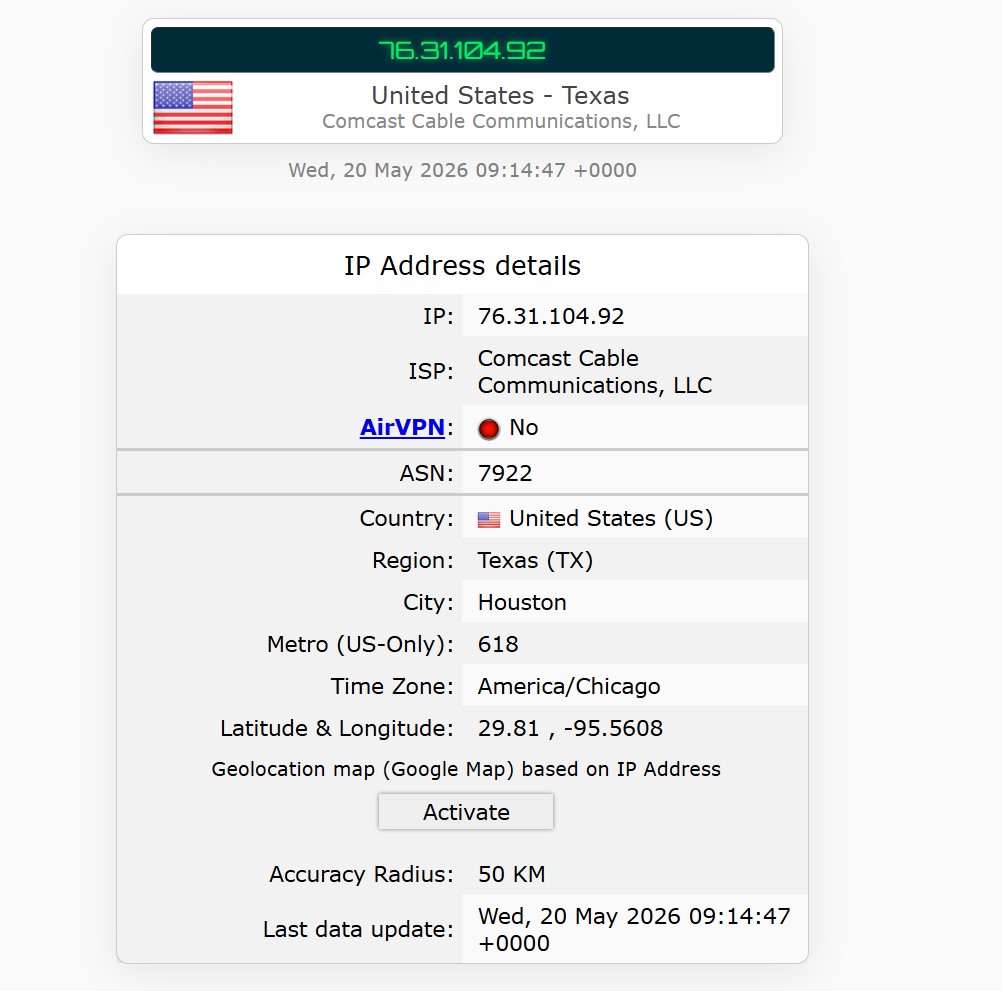
The third IP I caught during rotation — 76.31.104.92, also Comcast, also Houston. And on this one I got the full picture — both the pros and cons of real residential pools.
Hostname with reverse DNS — this matters
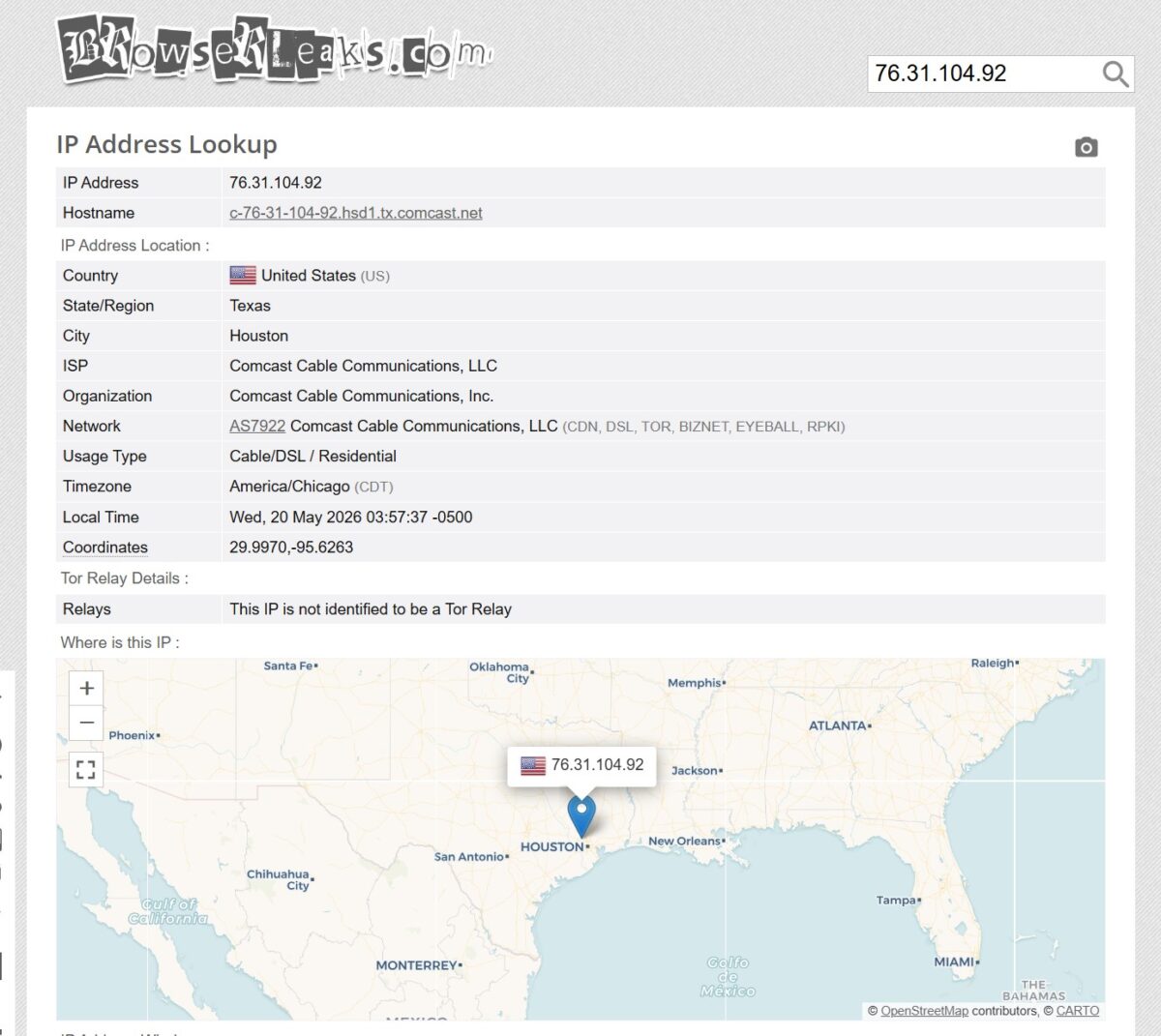
This is critical. With a lot of providers (hi there, certain $1/GB competitors), reverse DNS gives you something like host.datacenter-provider.net or just an empty PTR. Here you get a live comcast.net hostname with the hsd1.tx pattern (high-speed data, Texas). Antifraud systems read that and trust it.
Whoer-style check
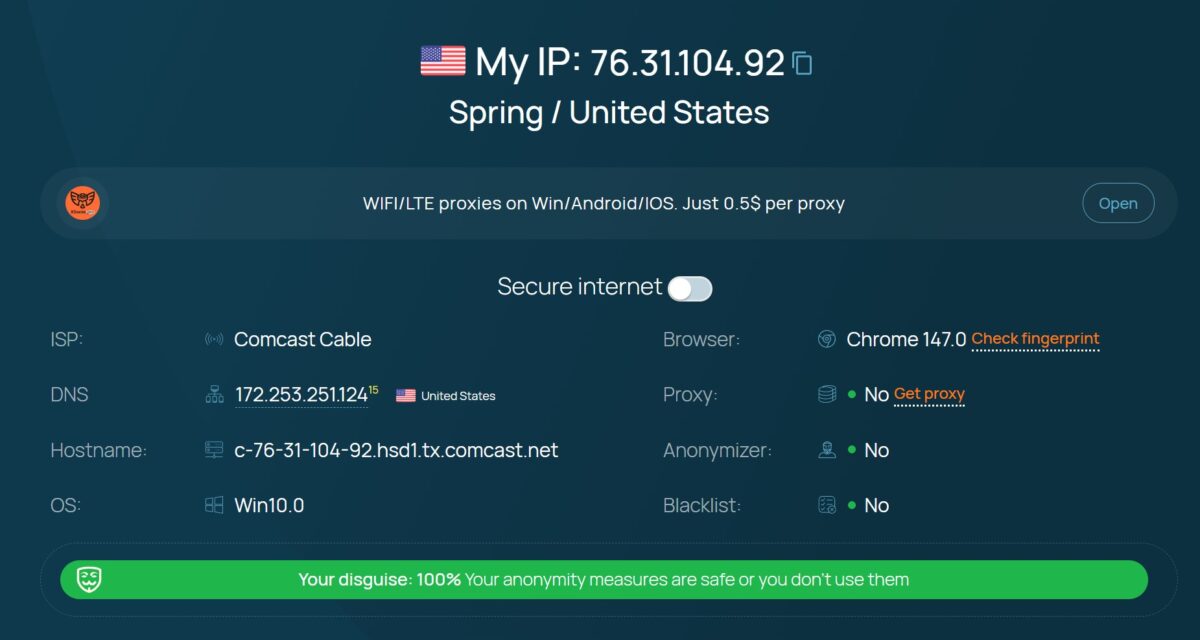
The service shows 100% anonymity. Proxy not detected, anonymizer not detected.
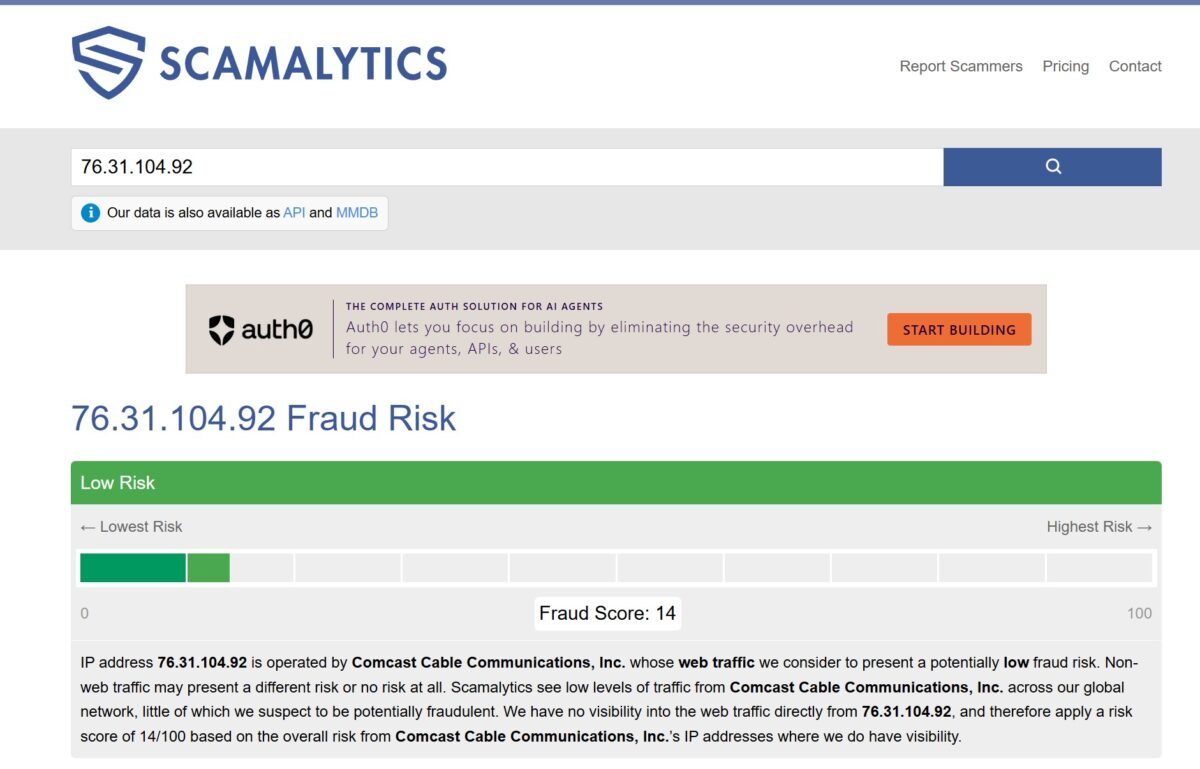
Scamalytics Fraud Score
And now the downside — blacklists
Writing it as it is, because I promised an honest review.
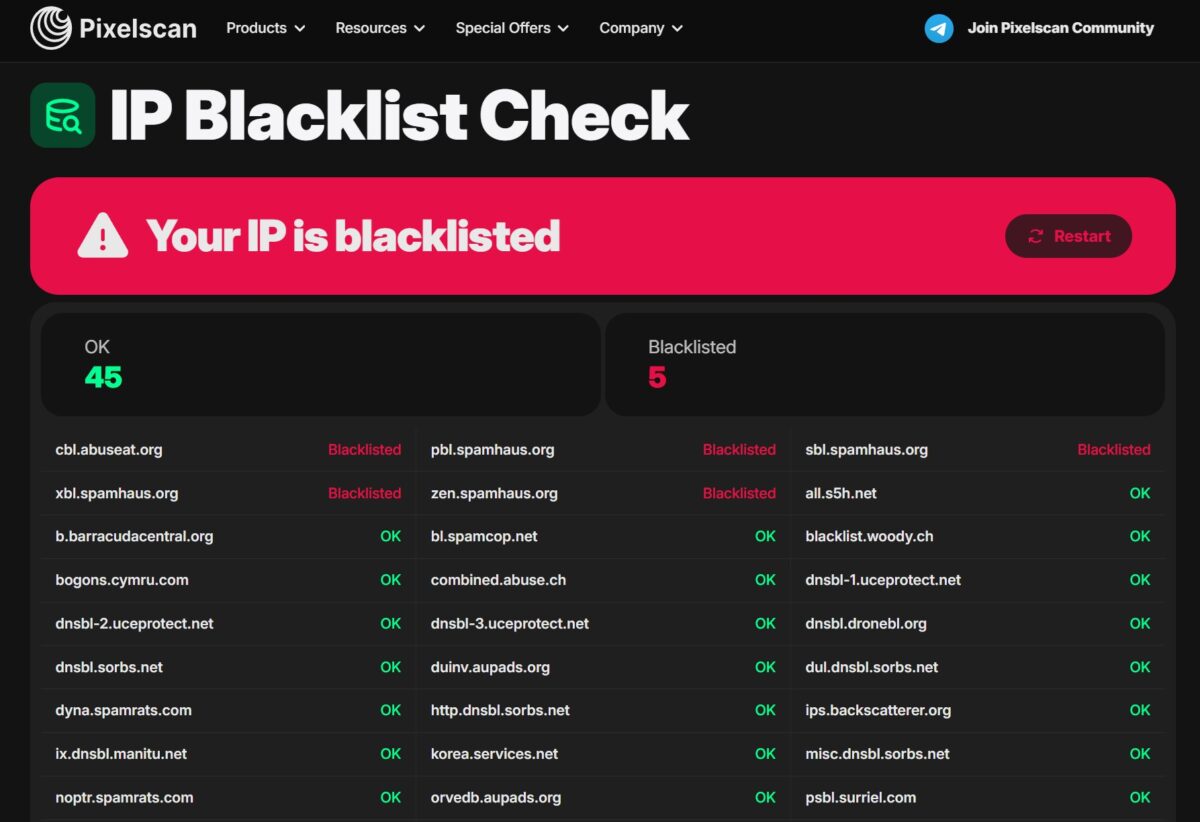
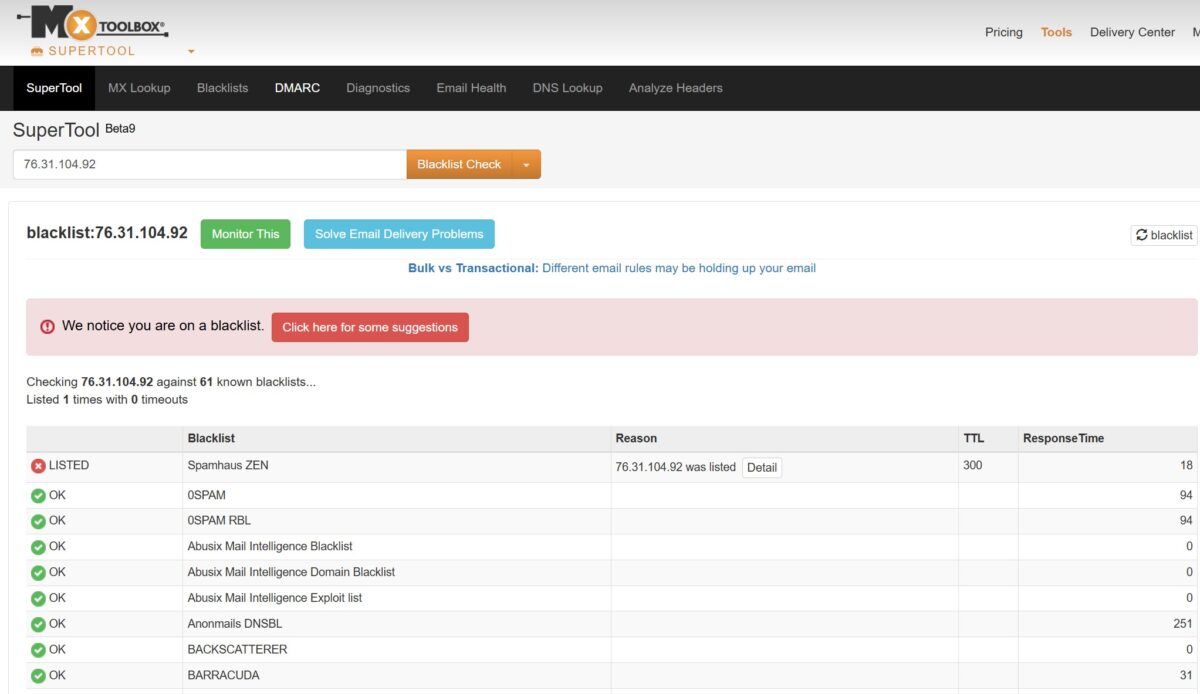
What this means and how critical it is. Spamhaus PBL/ZEN is the Policy Block List, and per Spamhaus policy, all dynamic ranges of major ISPs end up there, Comcast included. Meaning it’s a “this IP shouldn’t send SMTP mail directly” marker, not a “this IP is a spammer” one. Reddit, Instagram, Amazon, Google, eBay, LinkedIn don’t know or care about these lists — what matters to them is ASN, hostname, fraud score, and behavior.
Try it yourself — take the home IP of your own provider (Comcast, AT&T, Spectrum, Verizon) and run it through MXToolbox. 95% chance you’ll see the same Spamhaus PBL. That’s how it’s supposed to work. This is confirmed on Comcast’s own forums — the provider itself states that its consumer IP ranges are in PBL by design.
WebRTC — now this is funny
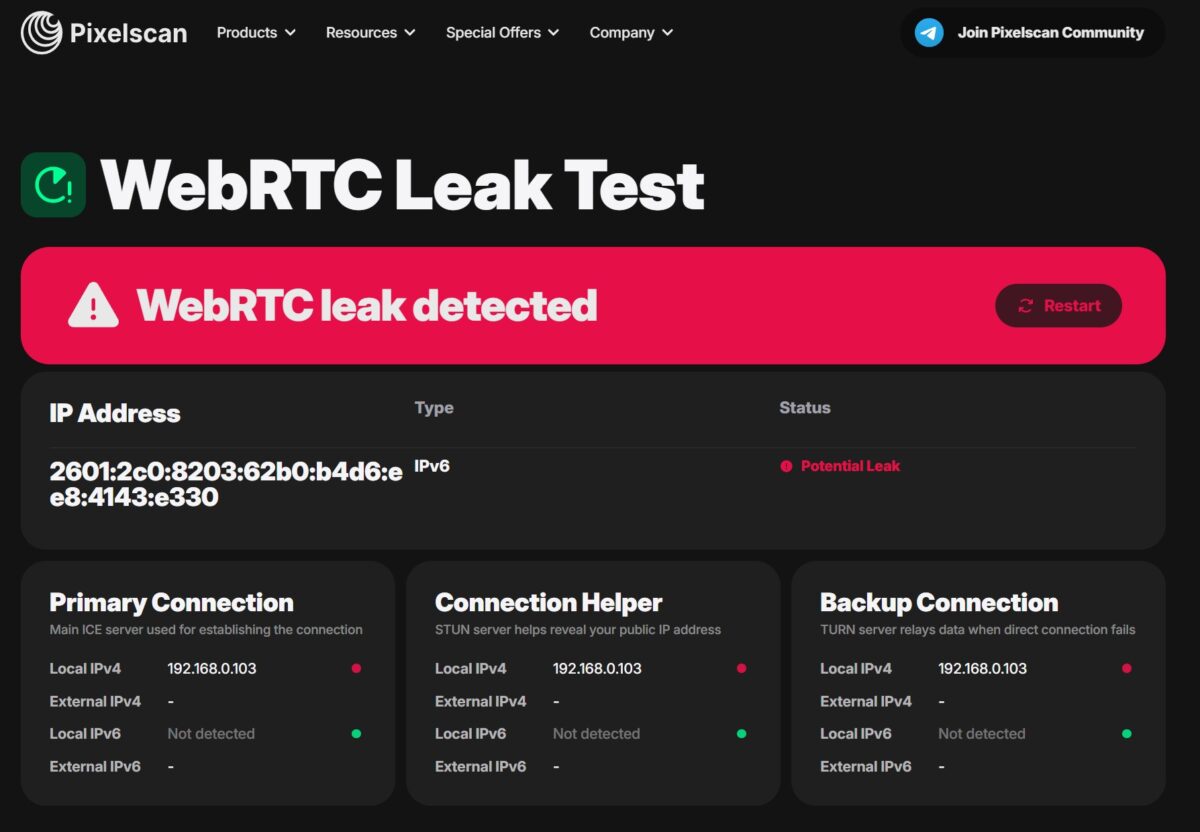
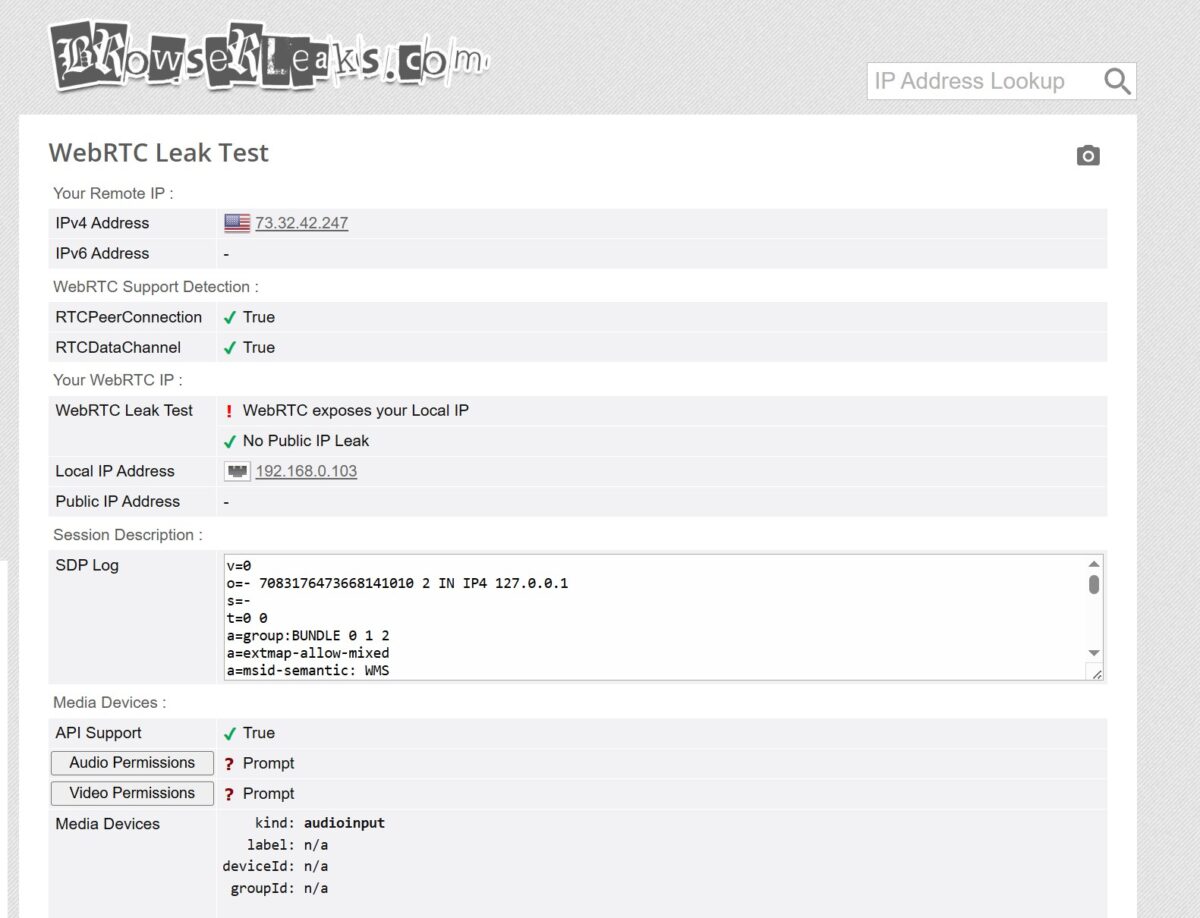
Important to understand here: this is not a proxy problem, it’s a browser problem. WebRTC exposes the IP at the browser API level, not at the network stack level — an HTTP proxy physically cannot intercept those requests. Antidetect browsers (Multilogin, GoLogin, Dolphin, AdsPower) have a dedicated toggle “WebRTC: replace public IP with proxy IP”. Flip it on, no leak. I tested from regular Chrome to see things “as is”.
Speed
Ran fast.com a few times, because a single measurement isn’t a measurement.
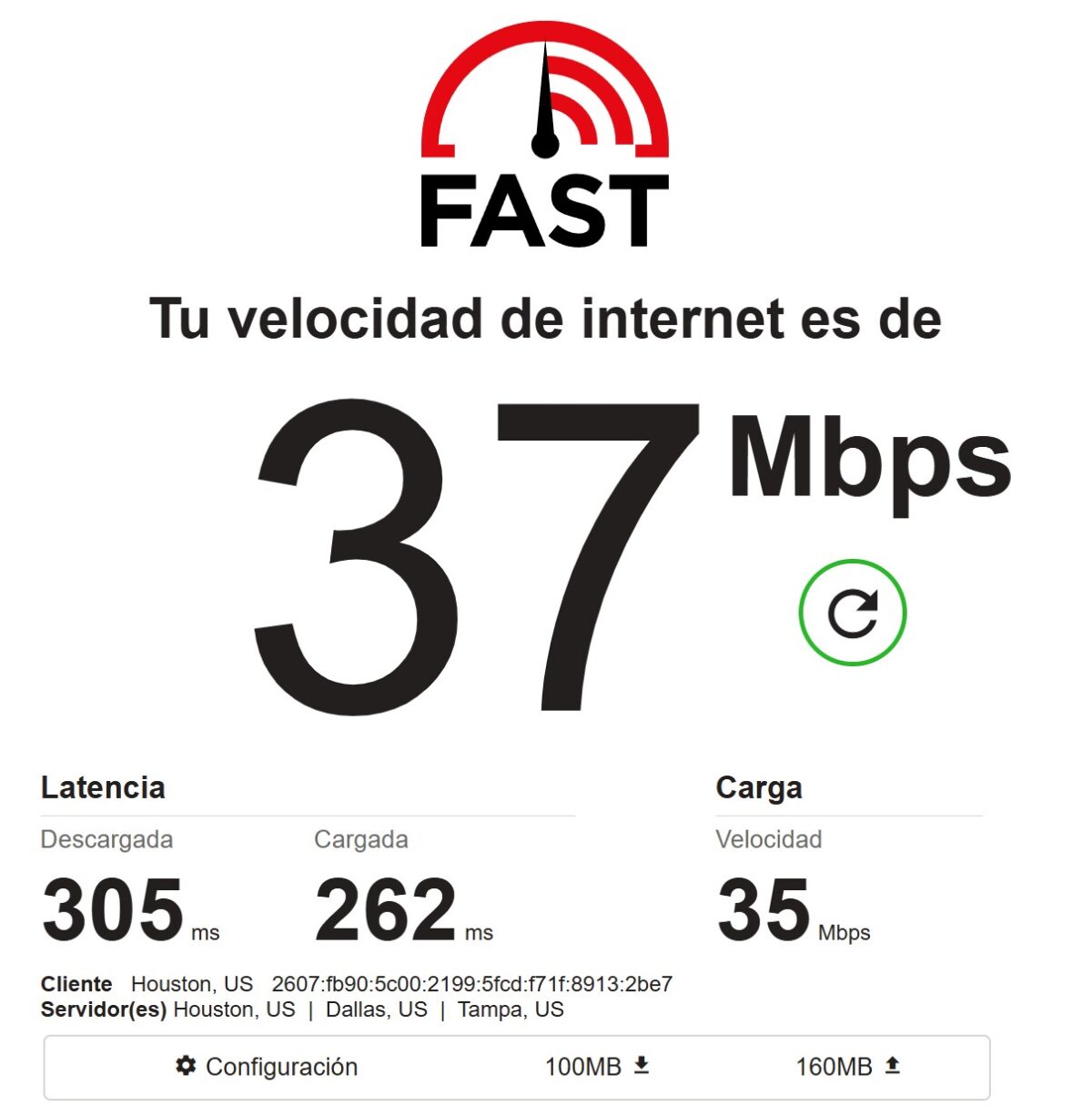
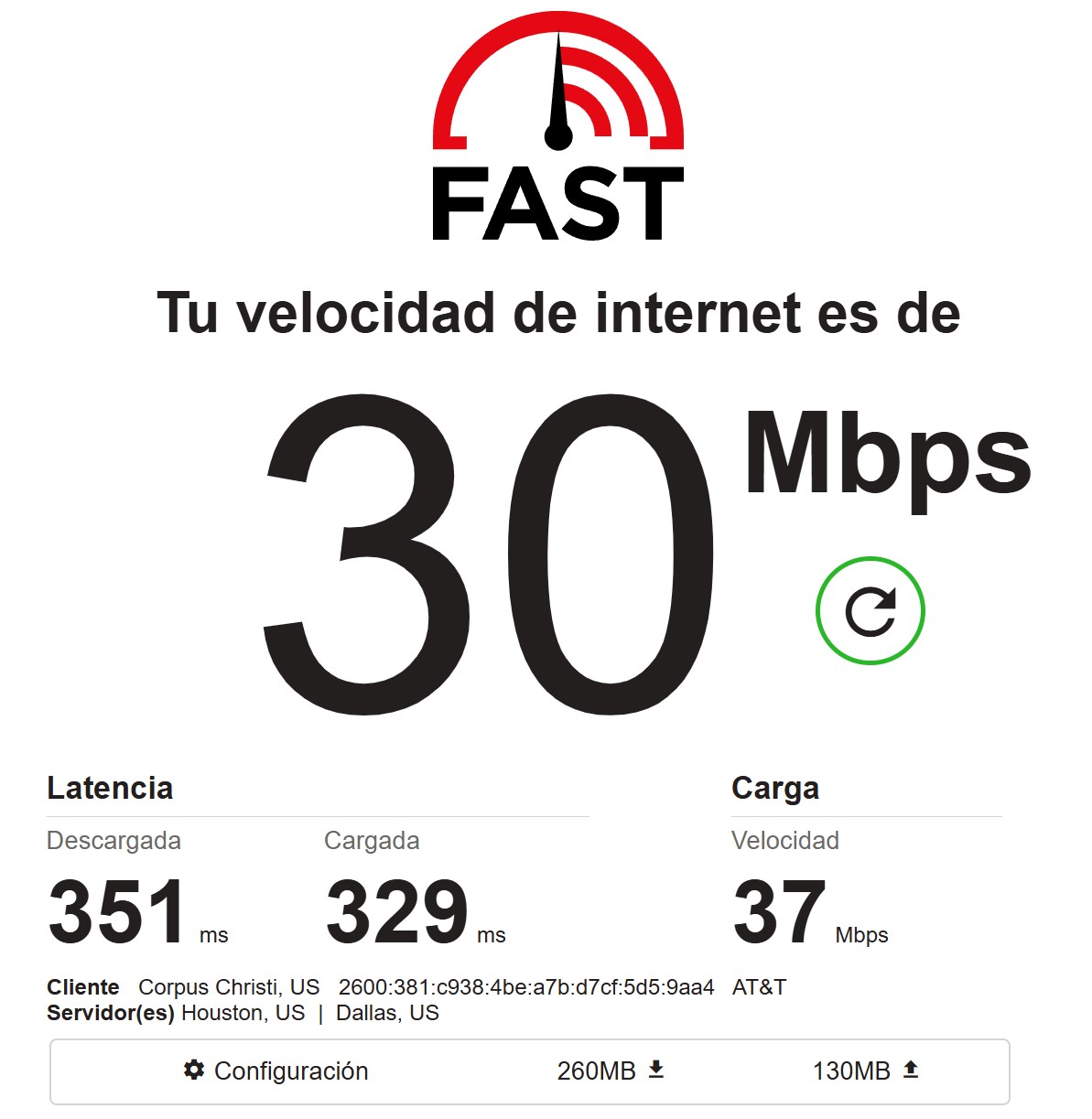
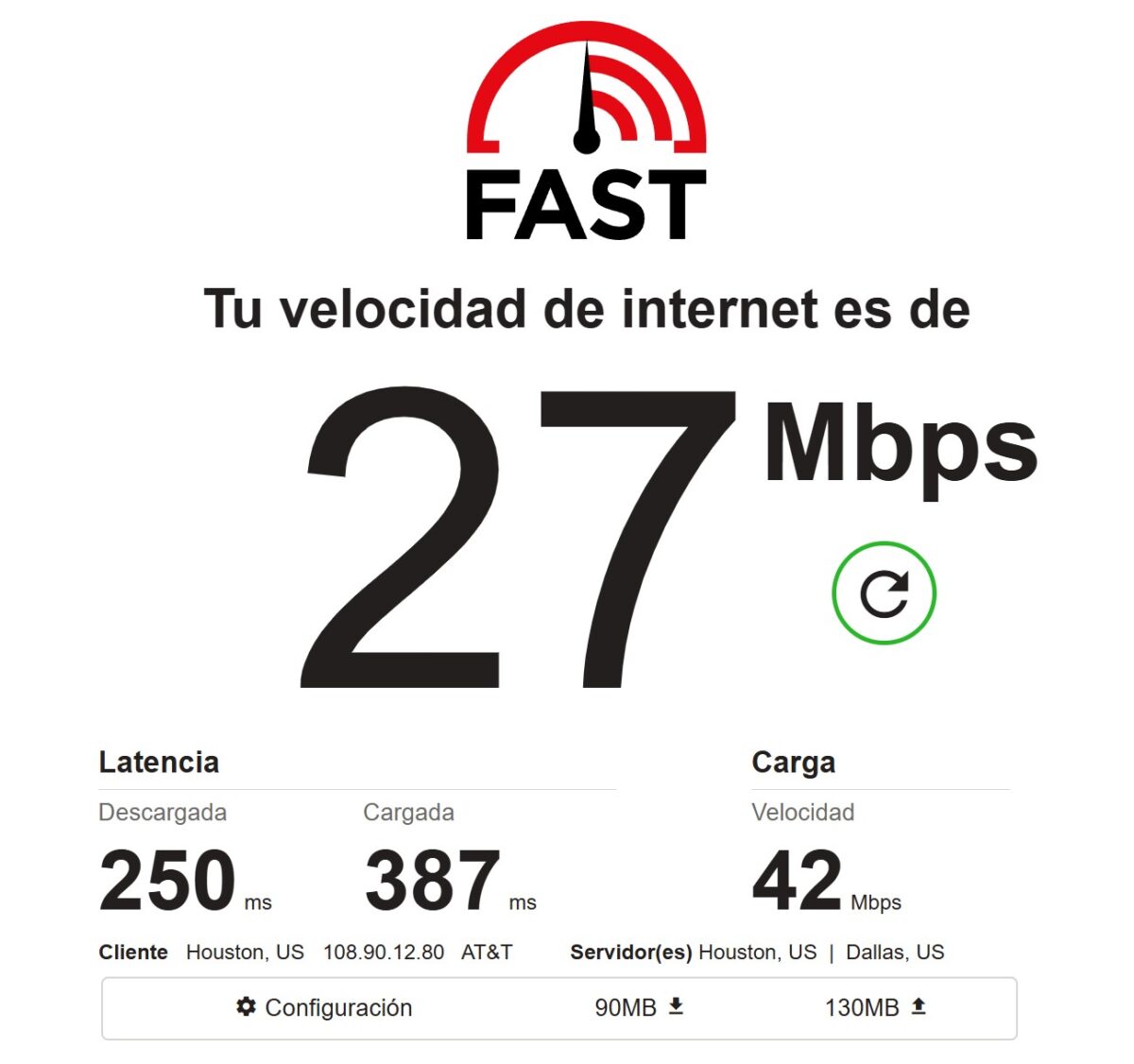
On average — 27-37 Mbps download, 35-42 upload. For residential proxies that’s a normal, mid-market number. With premium providers like Bright Data you’ll see 50-80 Mbps on good nodes, with budget ones — 10-20. Floppydata sits in the middle, closer to the top of the budget range.
Latency 250-350 ms. Not for HFT, but for scraping, clicks, and Reddit activity — plenty of headroom.
Global latency: checked via Byteful Proxy Tester
Local speed through fast.com is half the picture. A proxy can respond fast to a client in the US and still lag for someone in London or Singapore. Ran the proxy through byteful.com/proxy-tester — this tool pings the proxy from multiple geo points simultaneously and shows the real latency for each region.
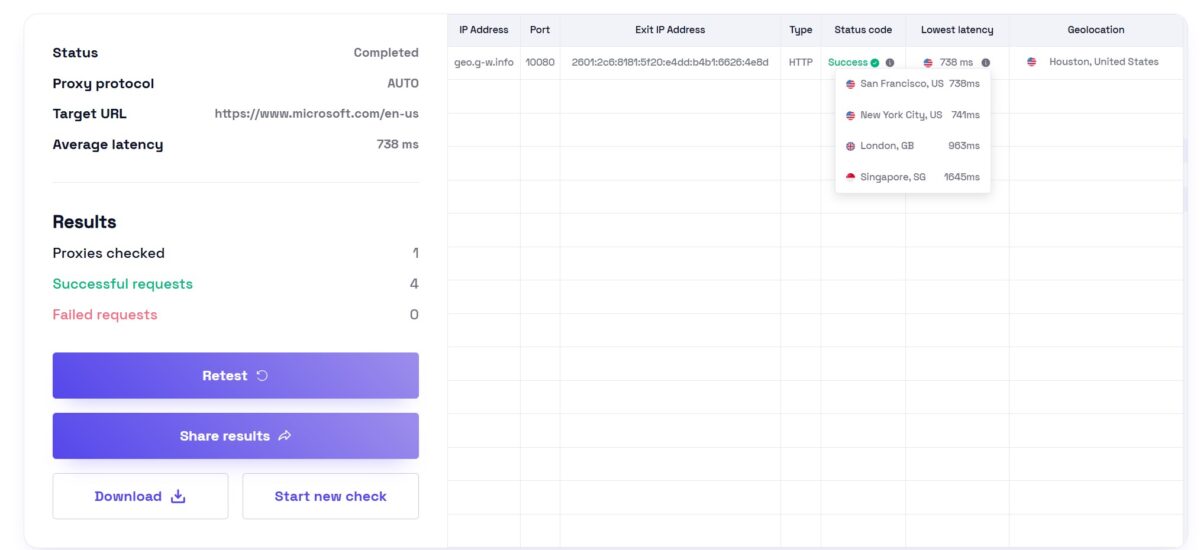
Results per measurement point:
| Measurement point | Latency | Verdict |
|---|---|---|
| 🇺🇸 San Francisco, US | 738 ms | ✅ Good for a transcontinental hop |
| 🇺🇸 New York City, US | 741 ms | ✅ Stable |
| 🇬🇧 London, GB | 963 ms | 🟡 Normal for US→EU over residential |
| 🇸🇬 Singapore, SG | 1645 ms | ⚠️ Noticeable lag |
100% Success Rate — 4 out of 4 requests went through, zero failed. This lines up with the 20/20 OK I got in FOGLDN. Network stability with this provider on tested IPs is honestly good.
Latency verdict: for US/EU tasks Floppydata fits without question. For Asian ones — better to grab pools from the matching regions instead of trying to reach Asia through a Houston exit.
Separate load test via FOGLDN
Ran 20 sequential requests against google.com through FOGLDN Proxy Tester. To see how stable it is under load.
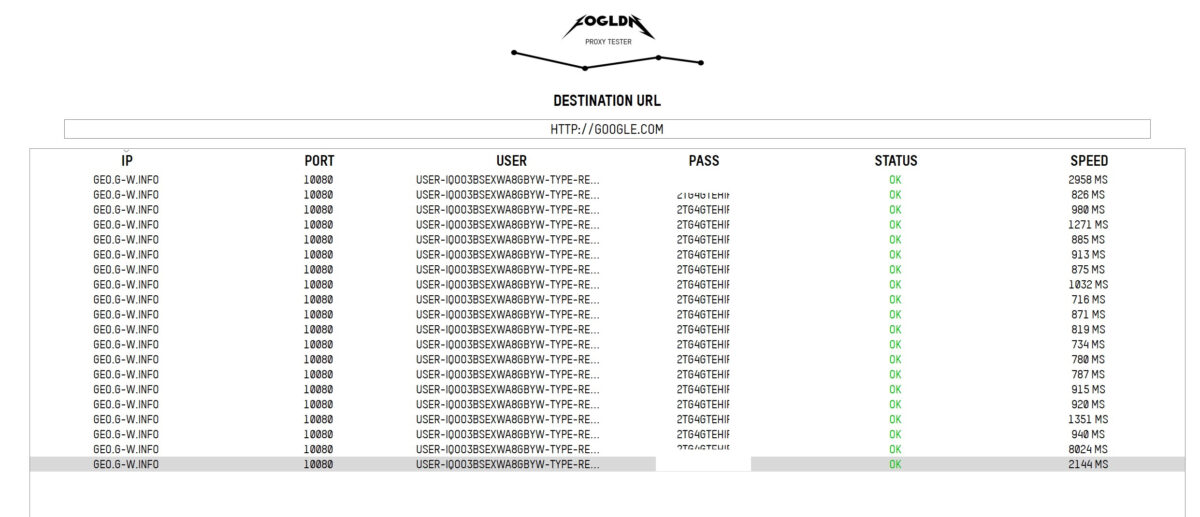
What I see: not a single failed request out of 20, 100% availability. Median response 880 ms — that’s adequate for residential. But there are two outliers — 8 seconds and 3 seconds. Where do they come from? Most likely the exit node was overloaded at peak or an internal rotation happened — sticky sessions have their quirks. Not critical for scraping (lose one request, retry it). For auction snipes or betting — already bad.
Compatibility and integrations
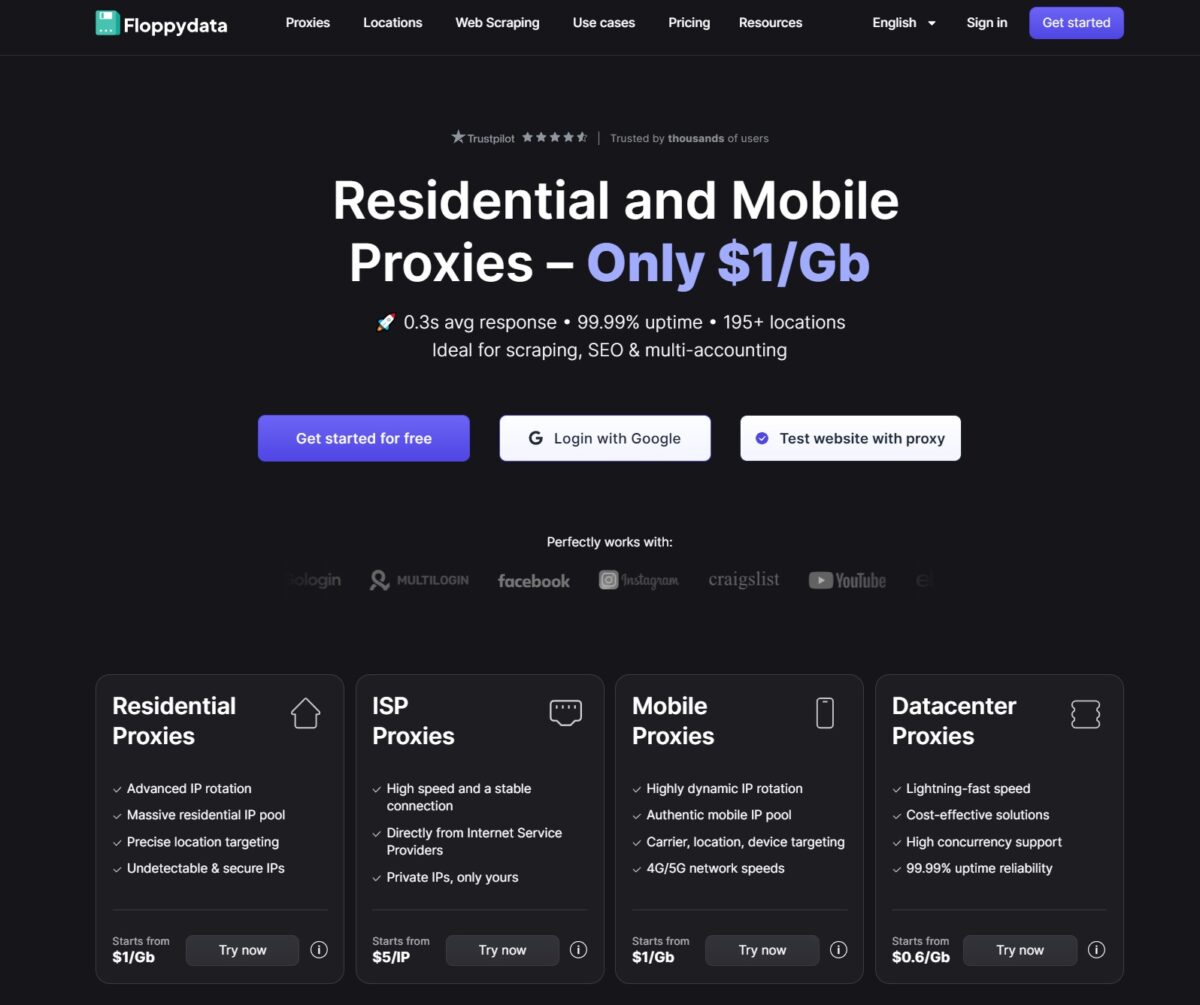
Antidetects plug in easily. I personally tried Dolphin{Anty} and Multilogin — the quick-input string parses automatically, didn’t have to type anything by hand. On the Floppydata homepage, integrations with GoLogin, Multilogin, Facebook, Instagram, Craigslist, YouTube are listed explicitly.
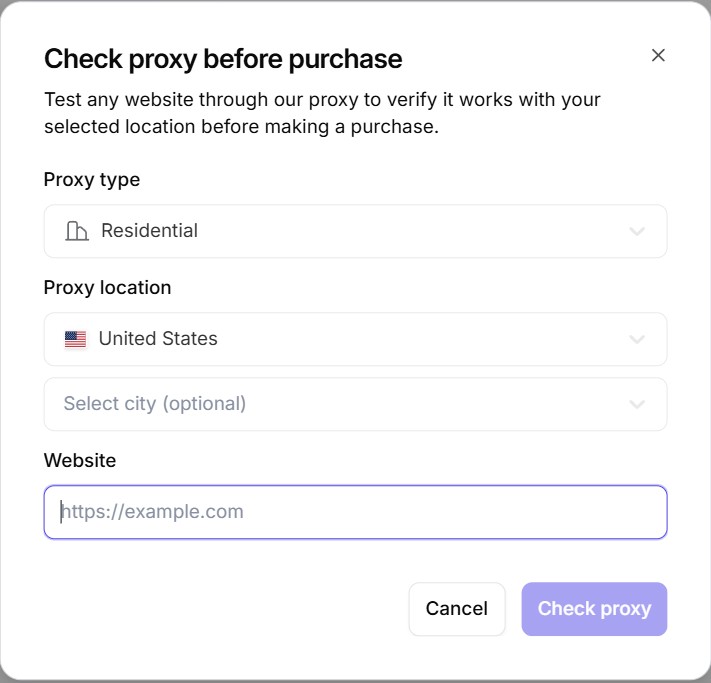
The dashboard has something I haven’t seen anywhere else — a site tester through the proxy before purchase. You specify type, location, target URL — and the service runs it through their pool, shows if it works. Handy when you’re not sure whether a specific site accepts an IP from your chosen city.
Location coverage
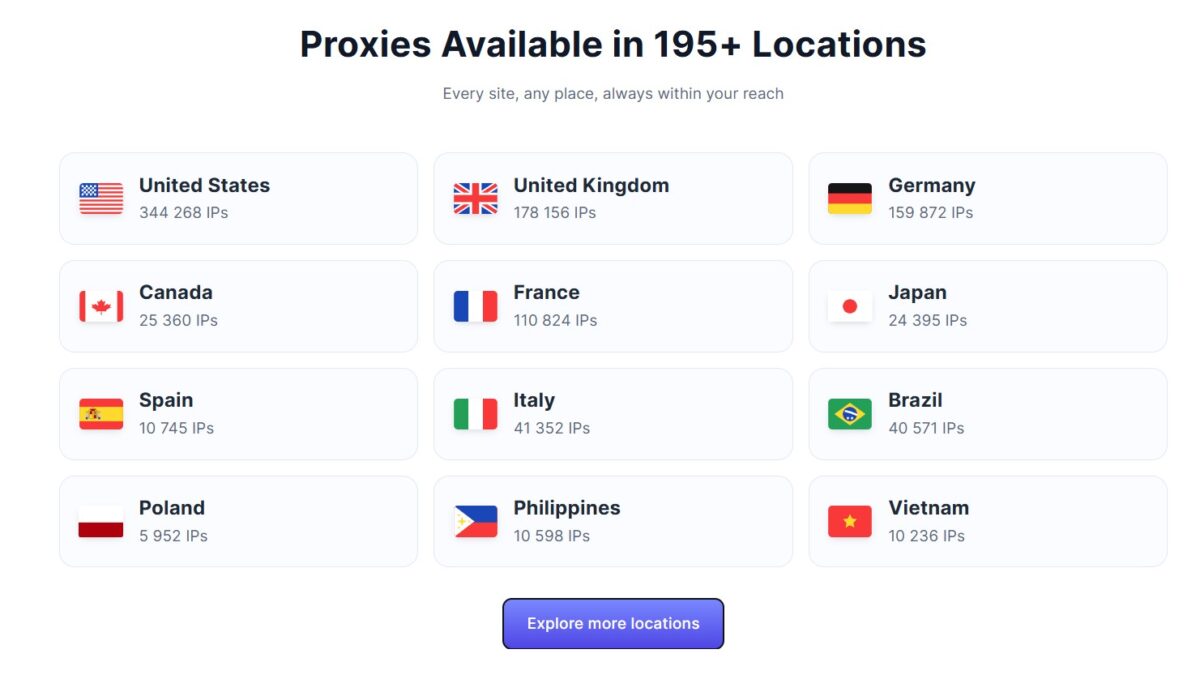
The top-12 countries alone hold ~962,000 IPs. Claimed 195+ locations — in line with Bright Data and Smartproxy. What I liked: strong pool in the US (344K) and Western Europe (UK+DE+FR ≈ 450K), some Asia (Japan 24K, Philippines 10K, Vietnam 10K). What’s not great: Eastern Europe is thin (Poland just 5,952 IPs), Latin America outside Brazil — basically nothing.
Pricing
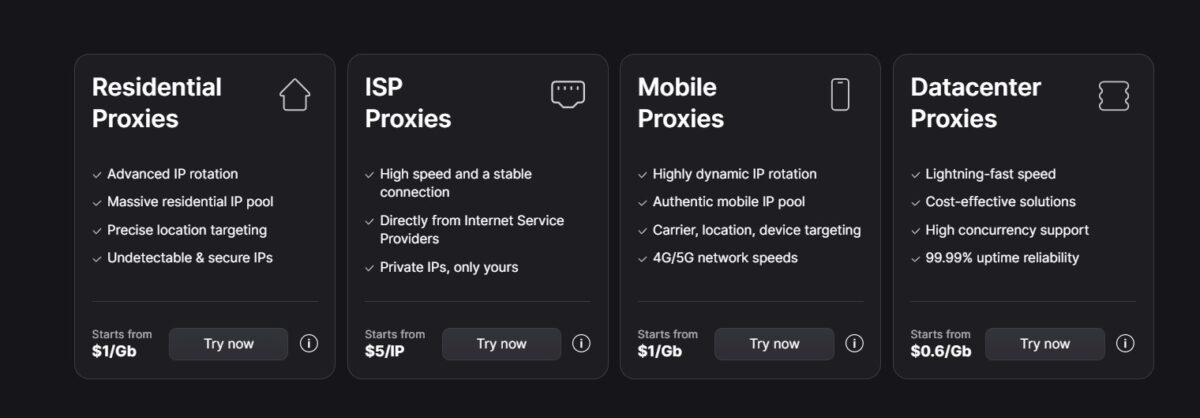
Simple. By the 2026 price list, Floppydata is one of the most aggressive on the market on pricing. Compare with competitors on their own pages:
- Bright Data — residential from $3.53/Gb (current pricing)
- Oxylabs — from $3.49/Gb
- Smartproxy (Decodo) — from $3/Gb
- IPRoyal — from $1.75/Gb (at high volumes)
- Floppydata — from $1/Gb on subscription, $1.50 pay-as-you-go
A 3-4x gap. Where the price comes from is a separate question (pool scale, sourcing method, the provider’s unit economics). But the fact is: at the quality I saw in testing, the price-to-quality ratio is excellent.
One catch. PAYG is 50% more expensive than the subscription. If you plan to use more than 5-10 GB — the subscription is the better deal. If it’s a one-off 2 GB task — go PAYG, don’t bother with auto-billing.
What I didn’t like
No rose-colored glasses. What actually bothered me:
1. The proxy dropping 30 minutes into testing. Recovery via session token swap is fast, but it still leaves a bad taste. On production load, you have to account for these dips with retries and a pool of backup sessions.
2. Spamhaus listings. Technically — “not a bug, a feature” of PBL policy. Practically — you need to know that this IP won’t work for email tasks. For everything else — doesn’t matter.
3. Speed under spikes. One 8-second outlier out of 20 FOGLDN requests — not critical, but in high-frequency scenarios you need to factor it in.
4. Weak regions. If you need Eastern Europe or LatAm — the pool is genuinely small.
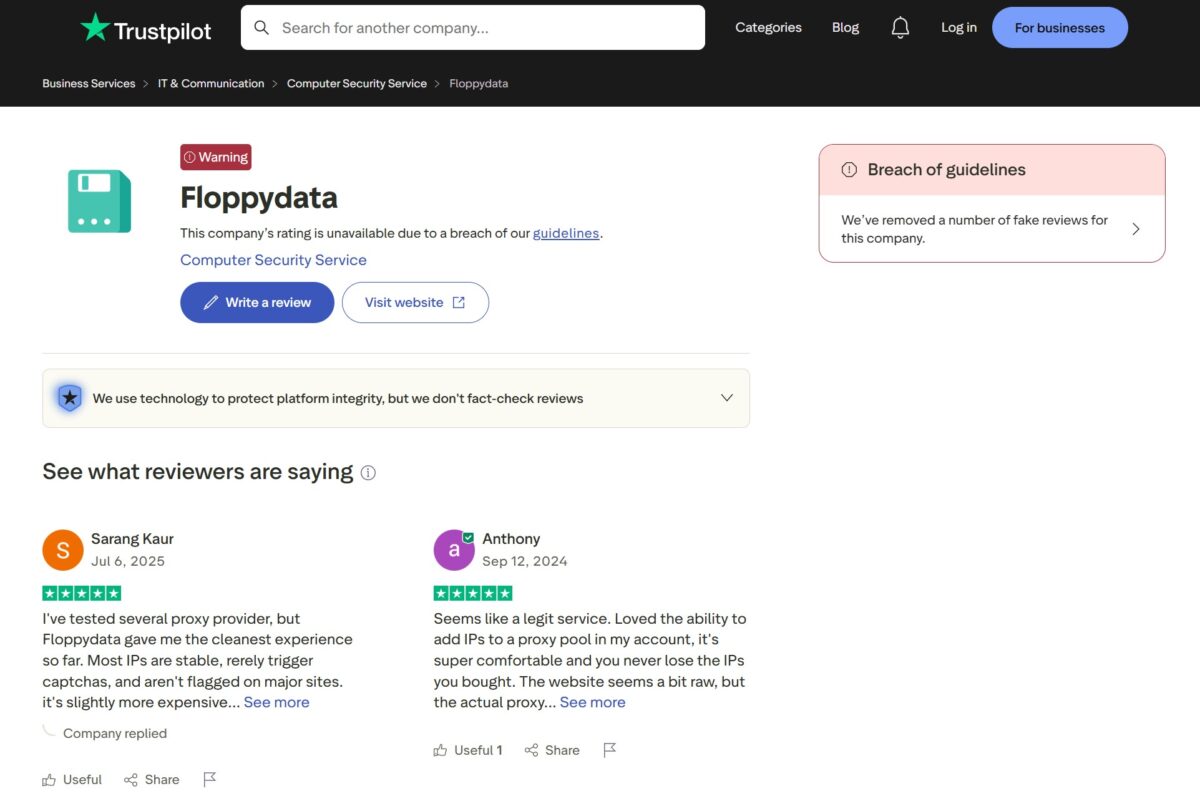
5. Floppydata had a shady history of fake Trustpilot reviews — at one point the platform hid their rating after detecting a network of bogus reviews. The profile has been restored now, but it happened, and I can’t leave it out of the review.
What I liked
- Real ISP IPs from Comcast/AT&T with correct reverse DNS
- Clean fraud markers (0/79 detections, fraud score 14/100)
- Proxy config constructor — fast, flexible
- Built-in IP Rotation Checker and Pre-purchase tester — nice little touches
- Price 3-4x lower than Bright Data at comparable IP cleanliness
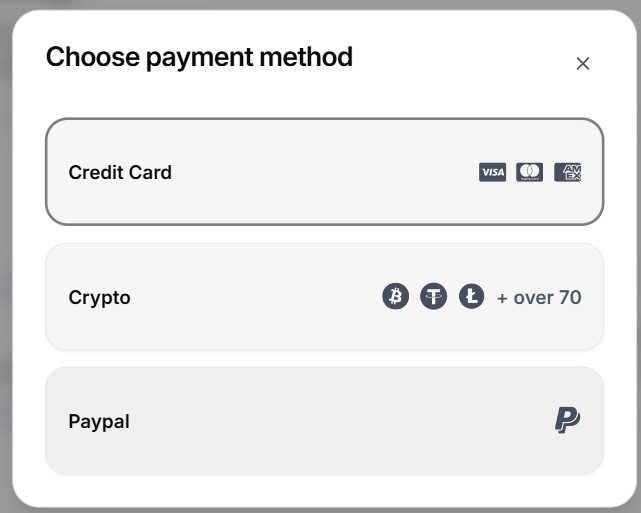
- Crypto payments (70+ currencies) — convenient
- SOCKS5 supported with DNS resolving on the proxy side
Does this work for Reddit
The main question I started this whole thing for. Reddit since 2023 has been tightening antifraud hard, bans on datacenter ASNs, loves fingerprint clusters, as the admins of proxy subreddits discuss themselves.
What you need for a Reddit farm:
- Residential or ISP (not datacenter) — ✅ Floppydata has honest Comcast/AT&T
- Sticky session of at least 10-30 minutes — ✅ available, up to 60 minutes out of the box
- Stable hostname (PTR on ISP) — ✅ comcast.net domain in reverse DNS
- Low fraud score — ✅ 14/100 on Scamalytics
I’m throwing Floppydata into production on a test batch of 20 accounts and in a month I’ll write a separate post on how they hold up. For now, on paper and in tests — it checks out.
Final test results
Rolled all the measurements into one table — handy for a quick scan.
| Metric | Result | Rating |
|---|---|---|
| Download / Upload Speed | 27-37 Mbps / 35-42 Mbps | 4/5 |
| Latency US→US (byteful) | 738-741 ms | 5/5 |
| Latency US→EU / US→Asia | 963 ms / 1645 ms | 3/5 |
| Success Rate (FOGLDN, 20 requests) | 100% (median 880 ms) | 5/5 |
| Fraud Score | 14/100 Scamalytics, 0/79 IPQS | 5/5 |
| Blacklists | 1/61 MXToolbox (only Spamhaus PBL) | 4/5 |
| ISP Type | Residential, AS7922 Comcast | 5/5 |
| Reverse DNS | c-76-31-104-92.hsd1.tx.comcast.net | 5/5 |
| Proxy Detection | Not detected (Pixelscan, Whoer, IPinfo) | 5/5 |
| DNS Leak | No leaks | 5/5 |
| WebRTC Leak | IPv6 exposed without antidetect | 3/5 |
| Browser Fingerprint | Consistent | 5/5 |
| Geo Targeting | City + state + ASN, no surcharges | 5/5 |
| Sticky Session | Up to 60 minutes, stable | 5/5 |
| US / global pool size | 344K IPs / 65M+ across 195 countries | 5/5 |
| EE and LatAm coverage | Weak | 2/5 |
| Price (subscription / PAYG) | $1.00 / $1.50 per GB | 4/5 |
| Exit node stability | One drop in 30 minutes of testing | 3/5 |
| Refund Policy | 3 days + under 1 GB used, crypto non-refundable | 2/5 |
| Average score | across 19 metrics | 4.2 / 5 |
- Fraud Score 14/100 on Scamalytics and 0/79 detections on IPQS — one of the best cleanliness scores in the budget segment;
- Pixelscan doesn’t detect the proxy, browser fingerprint is consistent;
- Residential classification confirmed by IPinfo, IP2Location, BrowserLeaks, and Whoer;
- valid reverse DNS c-76-31-104-92.hsd1.tx.comcast.net — not an empty PTR and not a datacenter hostname;
- real Comcast AS7922 — one of the top-3 US ISPs, ideal ASN for Reddit, Meta, and Amazon antifraud;
- city targeting at no extra cost — Houston by config, Houston in practice;
- sticky sessions up to 60 minutes out of the box, holds the IP steady;
- $1/Gb price on subscription — 3-4x lower than Bright Data and Oxylabs;
- 65M+ residential IPs in 195+ locations, strong US/UK/DE/FR coverage;
- SOCKS5 support with FQDN resolving on the proxy side — no DNS leaks;
- out-of-the-box integrations with GoLogin, Multilogin, Dolphin Anty, MoreLogin;
- 100% Success Rate on 20 requests in FOGLDN Proxy Tester and 4/4 in byteful;
- built-in tools: Check IP rotation, Pre-purchase site test, System Status;
- crypto payments (70+ currencies) and no aggressive KYC;
- proxy config constructor — country, city, state, ASN, rotation in one click.
- speed 27-37 Mbps — mid-tier, not for mass HD streaming or heavy parsing of large files;
- latency spikes up to 8024 ms across 20 FOGLDN requests — critical for HFT and snipe scenarios;
- one proxy drop in 30 minutes of testing — had to regenerate the session;
- US→Asia latency 1645 ms — Asian tasks through a US exit aren’t an option;
- IP in Spamhaus PBL/ZEN — not suitable for sending SMTP mail (typical policy for all Comcast/AT&T addresses);
- PAYG markup +50% — the actual price without subscription is already $1.50/Gb;
- weak regions: Eastern Europe (Poland 5,952 IPs), LatAm outside Brazil, Africa;
- WebRTC IPv6 leak in Chrome without antidetect — fixed with a toggle in Multilogin or GoLogin;
- past fake-reviews scandal on Trustpilot — trust in public ratings is tainted;
- strict refund policy: refunds only within 3 days and at less than 1 GB used, crypto non-refundable;
- no free trial for commercial pools;
- AdsPower not natively integrated — manual routing needed;
- Cloud Browser still in Soon status — promised, but not there yet.
Bottom line
Floppydata is a solid mid-tier provider with aggressive pricing and surprisingly good residential pool quality. I expected to get a disguised VPS farm with a fake PTR for $1/Gb. I got real Comcast Houston with a clean fraud score and valid reverse DNS. Nice surprise.
Will be useful for anyone who needs US IPs for scraping, social media multi-accounting, sneaker bots, Reddit farms, SEO checks of US search results, parsing Amazon/eBay. Won’t work for sending email (Spamhaus), HFT/betting (latency spikes), and regions outside US/EU/some Asia (weak pool).
Also keep in mind the 50% PAYG penalty and the fact that the service had an ugly review-fraud incident — keep that in mind when evaluating the “5-star” raves online.
residential US proxies without overpaying
from $1/GB
195+ locations
residential, mobile, ISP, datacenter