

 Why Trust Us?
ToProxyLab has been testing proxy services since 2025. We pay for most plans ourselves, and when a provider gives us test traffic we say so in the review — free traffic buys a place in the testing queue, nothing else. Every provider goes through the same speed, uptime and fraud-score checks, and we publish the real numbers, including the bad ones. A rating cannot be bought. Learn who we are and how we review proxies.
Why Trust Us?
ToProxyLab has been testing proxy services since 2025. We pay for most plans ourselves, and when a provider gives us test traffic we say so in the review — free traffic buys a place in the testing queue, nothing else. Every provider goes through the same speed, uptime and fraud-score checks, and we publish the real numbers, including the bad ones. A rating cannot be bought. Learn who we are and how we review proxies.
 MobileProxy
 IPRoyal
| Comparison |  MobileProxy |  IPRoyal |
|---|---|---|
Published: January 6, 2026Updated: August 19, 2026 | Published: January 12, 2026Updated: August 29, 2026 | |
| Overall rating | MobileProxy Updated: August 19, 2026Read ReviewTry Now | IPRoyal Updated: August 29, 2026Read ReviewTry Now |
| Performance & Speed | MobileProxy | IPRoyal |
| Uptime & Reliability | MobileProxy | IPRoyal |
| Pricing & Value | MobileProxy | IPRoyal |
| Customer Support | MobileProxy | IPRoyal |
| G2 | MobileProxy | IPRoyal |
| Trustpilot | MobileProxy | IPRoyal |
| Pricing |
|
|
| Billing | Min. deposit: 5$ Subscription Money-back - 7d | Min. deposit: 10$ Pay-as-you-go · Subscription Partial refund |
| Free Trial | Yes2 hours | No |
| Countries | 52 | 195 |
| Proxy pool | 220M | 64M |
| Proxy types | ||
| Protocols | ||
| Sticky session | 60 minutes | 7 days |
| API | Yes | Yes |
| Browser extension | Yes | Yes |
| Antidetect browsers |
Company Background and Sourcing Model
Okay, let’s start with the basics – who are these guys and where do they actually get their IPs from. Because that changes everything.
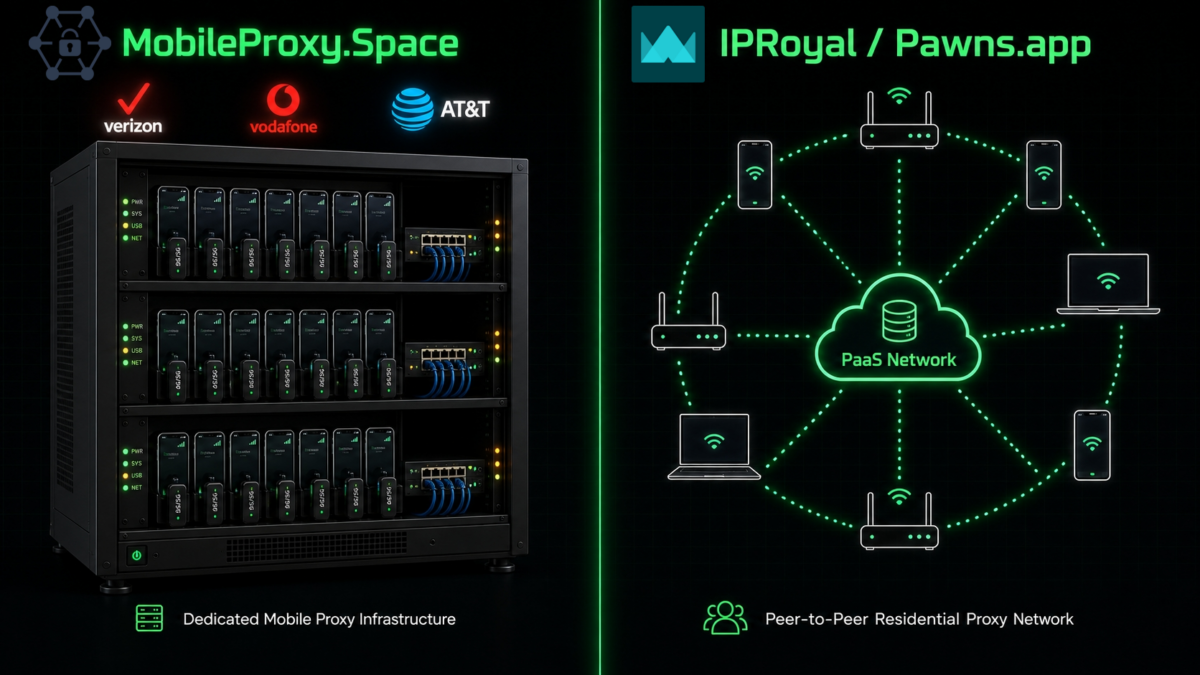
MobileProxy.Space is not a middleman. They run their own physical modem farm. Real USB modems and smartphones in racks. No virtualization, no emulation. They use CGNAT (Carrier-Grade NAT) technology – meaning when carriers like Verizon or Vodafone assign one external IP to thousands of real subscribers, you’re literally hiding in that crowd. Facebook physically can’t ban that IP without cutting off an entire neighborhood.
IPRoyal takes a different approach. They source their IPs through their own app called Pawns.app – an SDK-based network where regular people voluntarily sell their bandwidth for a small reward. Ethically, it’s a solid peer-to-peer model. But here’s the catch: when hundreds of users have already cycled through the same IP before you, the pool gets dirty. And that explains pretty much every difference you’ll see in the test results below.
Use-Case Breakdown: Which Service Fits Your Workflow
This is the most important section. Most people reading a “vs” comparison want one thing – which one should I use for my specific job?
Multi-Accounting and Account Farming
MobileProxy.Space wins here. You’re renting a dedicated channel – yours and yours alone. No neighbors burning through the same IP while you work. Add carrier-level targeting down to a specific operator (Megafon, Beeline, AT&T) and city, and you’ve got a serious edge for warming up Facebook or TikTok accounts.
Web Scraping and Data Collection
IPRoyal holds its own here thanks to 195-country coverage vs. 53 for MobileProxy.Space. If you need data from less common regions – Vietnam, Brazil, Nigeria – the choice is pretty obvious. Just be ready to screen every IP for cleanliness before putting it to work.
Affiliate Marketing and Ad Verification (FB/TikTok/Google Ads)
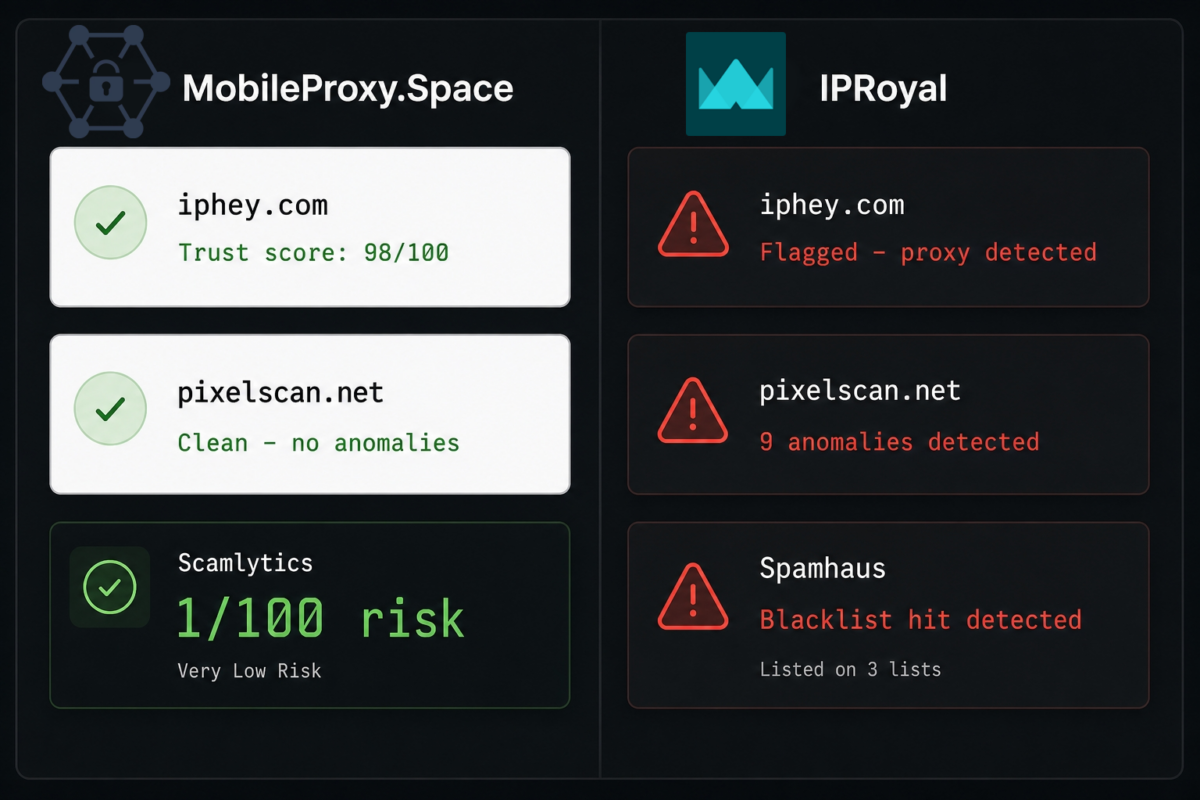
Real numbers from our tests: MobileProxy.Space scored a 1/100 risk score on Scamlytics, with green checks across iphey.com and pixelscan.net. IPRoyal threw red flags on iphey during the same test run, and one of the US mobile IPs came back already listed in Spamhaus. For platform-sensitive work, that’s a meaningful gap.
Sneaker Copping and Limited Drops
IPRoyal is the only one of the two with a dedicated Sneaker Proxies product. MobileProxy.Space simply doesn’t have that niche category. If you’re in the sneaker game – IPRoyal is your pick.
Price Monitoring and SEO Tracking
Look at the pool size: MobileProxy.Space has 268.7M IPs, IPRoyal has 64M IPs. For large-scale scraping with heavy rotation, MobileProxy.Space has the upper hand.
Performance Deep Dive: Speed, Latency, and Stress Testing
The comparison table shows scores – 4.0 vs 3.2 for speed. But you want the actual numbers, right?
MobileProxy.Space (Poland test, Play network carrier):
- Ping: 233-235 ms – yeah, it’s high. That’s just mobile network physics, nothing you can do about it.
- Download: 4-8.45 Mbps – not great for 4K streaming, but totally fine for running 10 AdsPower profiles.
- Upload: 10-22.48 Mbps – solid.
IPRoyal (US test, mobile proxies):
- Speed: 15-20 Mbps – faster on paper.
- But IP rotation lag hits 10-30 seconds. MobileProxy.Space keeps it to 10-15 seconds.
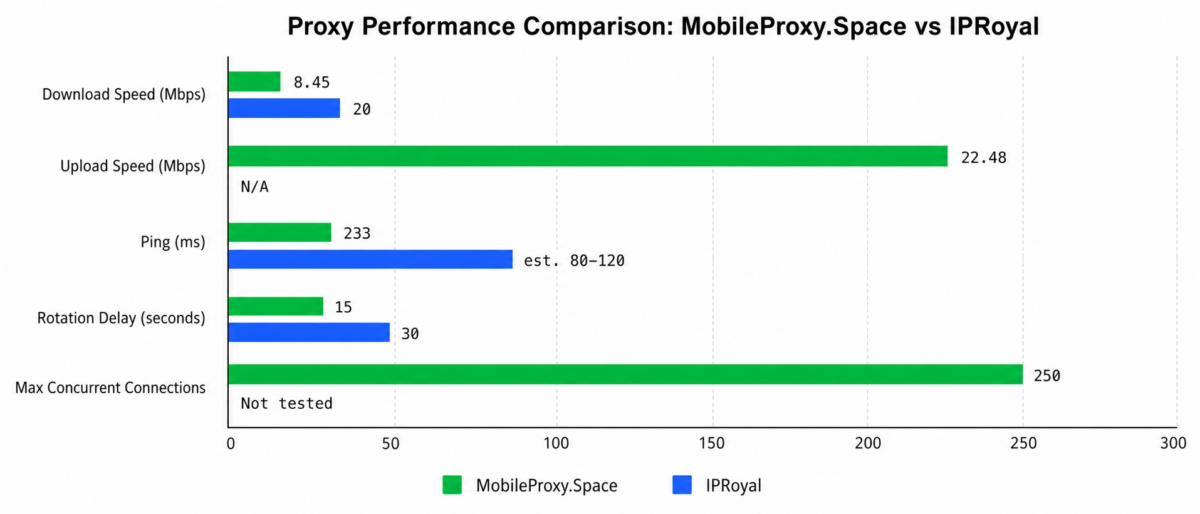
And here’s an exclusive data point from the MobileProxy.Space stress test – ZennoPoster, 100 threads, task: scraping heavy Amazon product pages. Result: held 250 concurrent connections. Speed dropped to 3 Mbps under load, but the proxy didn’t die. The one real downside – during IP rotation (modem reboot), the channel goes into a blackout for 8-12 seconds, which causes your software to throw connection errors. If you’re building automation templates, add a pause around the IP change step. Otherwise it’ll hurt.
IPRoyal has no comparable stress test data, which says something on its own – the service is positioned more for standard workloads, not extreme concurrency.
IP Rotation, Sticky Sessions, and Authentication
The table already covers the basics: sticky session duration is 60 minutes for MobileProxy.Space vs. 7 days for IPRoyal. But let’s dig into the mechanics.
MobileProxy.Space gives you two rotation modes. First is timer-based: auto IP change every N minutes (minimum 2 minutes), great for scraping. Second is link/API-based: the most convenient option for manual control. Hit an Action Block, call the API, get a clean IP from the same region in about 10 seconds.
IPRoyal works differently: sticky sessions up to 24 hours straight, or per-request rotation typical of residential pools. Every new request gets a new IP from the shared pool, no physical hardware reboot involved. So rotation is faster on paper, but the pool is shared with everyone else.
Both services support user:pass authentication and IP whitelist (IP binding). With MobileProxy.Space, you can switch between these methods on the fly directly from the dashboard.
Geo-Targeting: Depth Beats Breadth
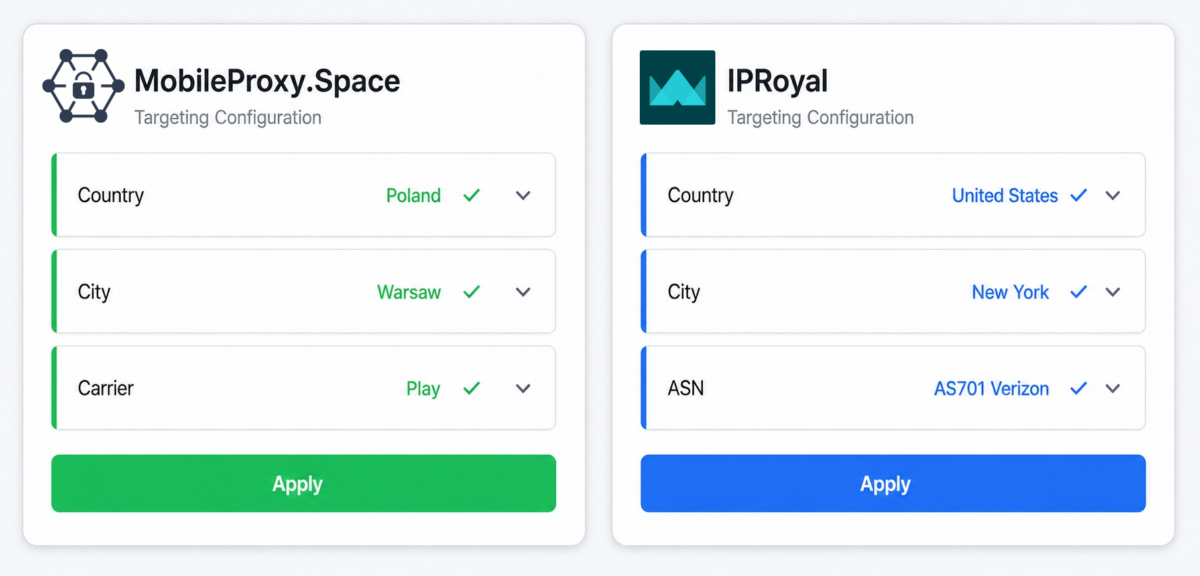
Both services advertise geo-targeting, but the underlying mechanisms are completely different.
MobileProxy.Space gives you three levels: country, city (not just “Russia” but specifically Samara or Krasnodar), and carrier (Megafon, Beeline, Yota, Vodafone, AT&T). That’s carrier-level targeting. If your campaign is getting flagged on the Tele2 subnet, you switch to Megafon in the same city in a couple of clicks. That’s powerful.
IPRoyal offers: country, city, and ASN (Autonomous System Number). ASN-level targeting is a different tool. It matters when you need a specific ISP to get around provider-specific blocks during scraping. But for mobile ad verification, carrier targeting is more precise.
The takeaway is simple: need carrier precision for mobile ads – go MobileProxy.Space. Need ASN flexibility for enterprise scraping – go IPRoyal.
Detection Resistance: Real Tests, Real Results
This is probably the most telling section for anyone doing platform-sensitive work.
MobileProxy.Space on iphey.com and pixelscan.net – green checks across the board. DNS resolves through the carrier and matches the proxy geo. No WebRTC leaks exposing the local IP. The passive OS fingerprint shows a real Android or iOS device – because there’s literally a real phone sitting on a physical modem. Scamlytics: 1/100 risk score – that’s about as clean as it gets.
IPRoyal showed problems in the same tests. iphey.com threw red flags. One of the purchased US mobile IPs came back already listed in Spamhaus – meaning someone before you had burned it hard enough to land it in spam databases. pixelscan.net wasn’t happy either.
To be fair, some of the flags could have been antidetect browser configuration issues. But the fact remains: a P2P pool is inherently dirtier than a closed modem farm. For sensitive work like FB account verification, passing TikTok moderation, or building Google Ads trust score – that gap matters a lot.
Integration, Tooling, and Documentation
Both services work with Multilogin, GoLogin, and Dolphin{anty} – you can already see that in the table. But let’s talk about what the table doesn’t cover.
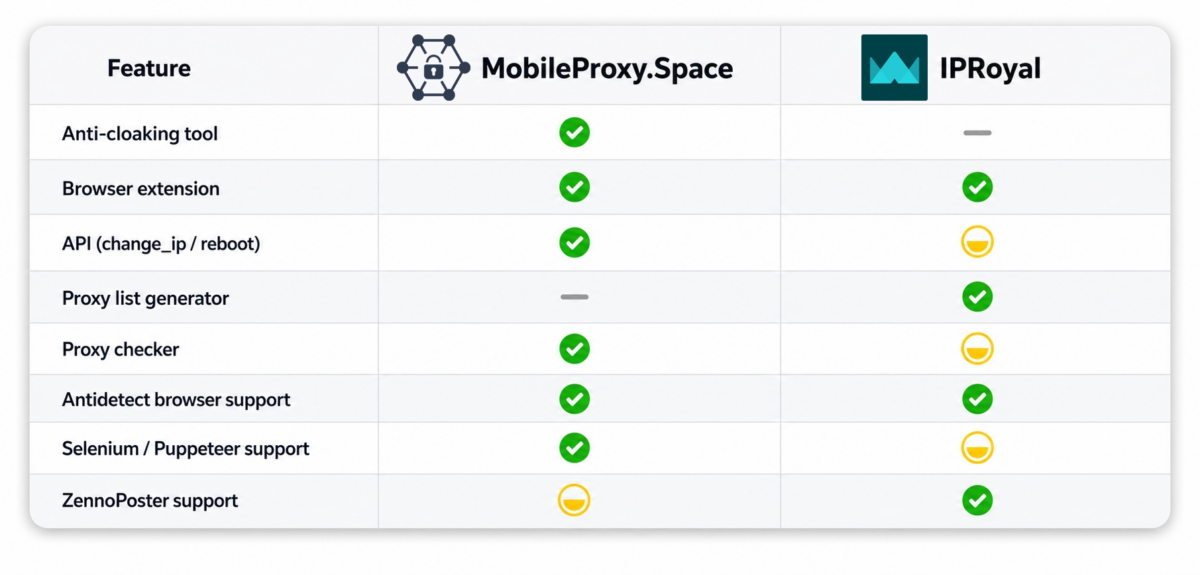
MobileProxy.Space bundles in some tools at no extra cost. An anti-cloaking tool built specifically for affiliates – lets you view competitor landing pages as a real user would, cutting right through cloaking. A browser extension with a one-click IP change button in the toolbar – small thing, but handy during manual testing. The API docs are solid: JSON responses, change_ip and reboot commands that work reliably. Hooking up a Python script takes about five minutes.
IPRoyal isn’t empty-handed either: there’s a proxy list generator (pick country, rotation type, format – user:pass or IP auth – and export as .txt), a free Chrome/Firefox extension for geo testing, a built-in proxy checker, and an API with decent documentation. It connected to ZennoPoster without any issues.
For Selenium, Puppeteer, and other automation frameworks, both services work the standard way via an HTTP/HTTPS proxy string.
Pricing: Real Scenarios, Not Marketing Speak
The table shows the headline numbers. But let’s translate those into real-world situations.
MobileProxy.Space sells time, not gigabytes. You’re renting a channel. Traffic is unlimited with no FUP. If you’re pulling terabytes of data while scraping or running video streams for account warming, this service pays for itself in a couple of days of heavy use. It can get pricey for Tier-1 geos though: a US or Australian channel can run $80-100+ per month. Minimum deposit is $5.
IPRoyal offers a mixed model: pay-as-you-go and subscription. Residential is $1.75/GB, Mobile is $10.11/GB, ISP is $1.80/IP, Datacenter is $1.39/IP. Minimum deposit is $10. But IPRoyal also sells mobile proxies on a flat-rate model (daily or monthly with unlimited traffic) – and for heavy scraping jobs, that’s genuinely cheaper than paying $7/GB at Bright Data.
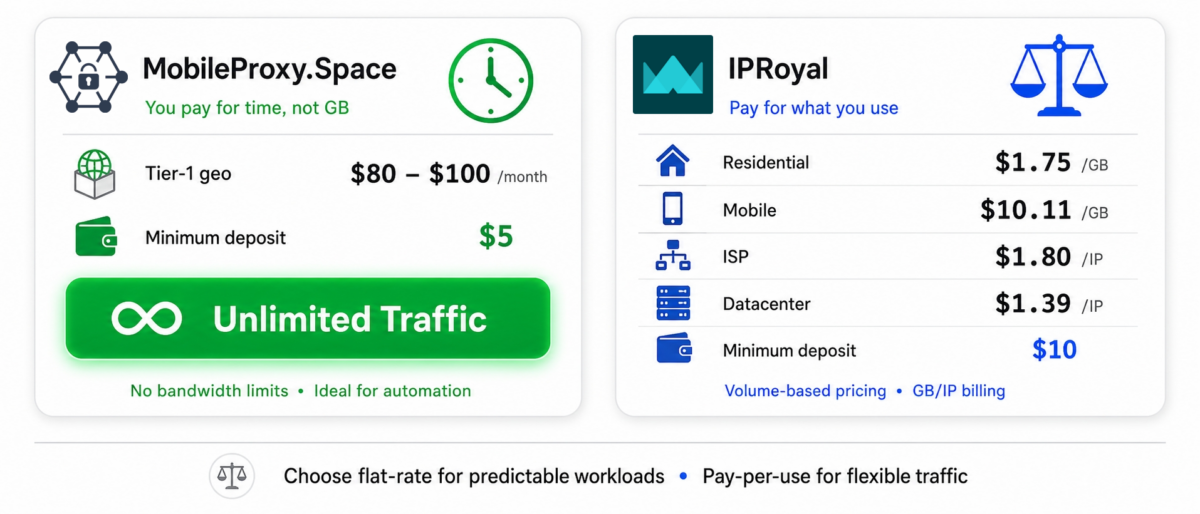
Break-even scenario for scrapers: If you’re pulling more than 15-20 GB per month through residential proxies, the MobileProxy.Space subscription model wins on cost. If your workload is irregular, IPRoyal’s pay-as-you-go gives you more flexibility.
Refunds – this is worth paying attention to. MobileProxy.Space offers a clean 7-day money-back guarantee, no questions asked. IPRoyal does partial refunds, and based on user feedback, it’s a headache: you buy, use it for a couple of hours, realize it doesn’t work for Ticketmaster, and getting your money back is a fight because “the service was rendered.”
Customer Support: The Story Behind the Scores
The table shows 4.6 for MobileProxy.Space vs. 5.0 for IPRoyal. But where do those numbers actually come from?
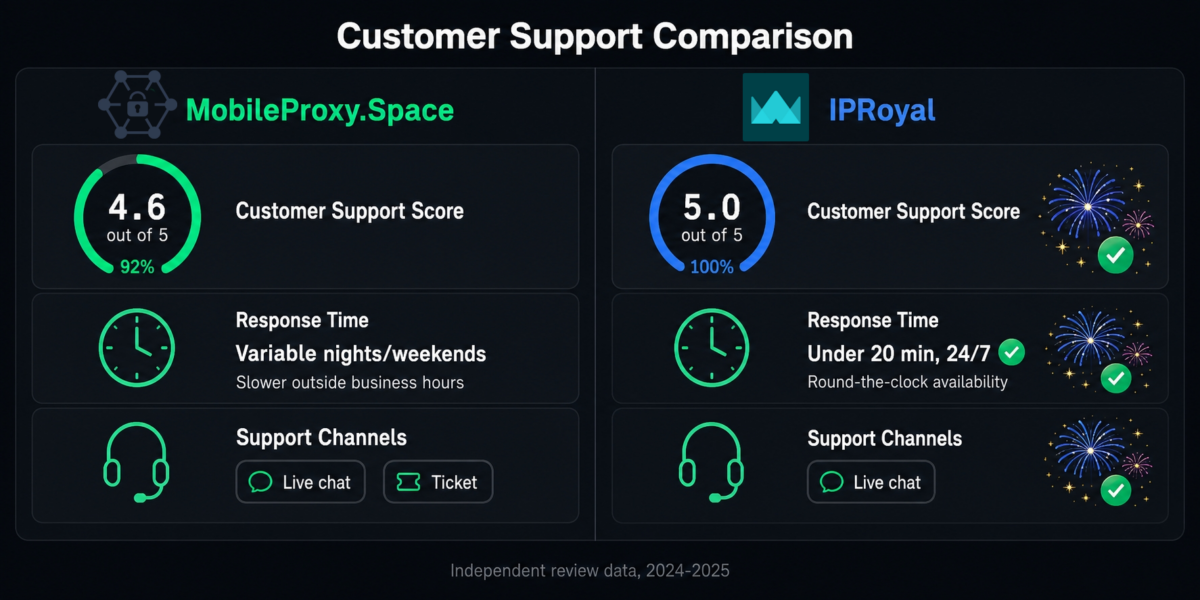
IPRoyal earned that 5.0 with a specific moment: New Year’s Eve, proxies went down. Midnight was right around the corner, support was obviously supposed to be off. Sent a ticket without much hope. 20 minutes later – reply, new credentials, proxies back online. That’s real respect. Most users on Trustpilot and BlackHatWorld back this up – support is genuinely fast and handles complex scraping issues right in chat.
MobileProxy.Space sits at 4.6. Still solid – the support team knows the product and gives useful answers. But there’s a catch: response times slow down noticeably at night and on weekends, even though they advertise 24/7 availability. If you work odd hours or operate in a different time zone, that’s something to factor in.
Reputation and Third-Party Reviews
The table shows IPRoyal with G2 4.7 (575 reviews) and Trustpilot 4.0 (2,618 reviews). MobileProxy.Space has dashes in both columns.
Why does MobileProxy.Space have no G2 or Trustpilot presence? Not because the service is bad. It’s because this is a niche, more underground product with a specialized audience – affiliates, media buyers, people doing account automation. That crowd doesn’t sit around writing public reviews on G2. They talk on BlackHatWorld and in private Telegram groups – different kind of presence.
IPRoyal actively manages its public reputation. What people praise: value for money, fast support, low barrier to entry. What they complain about: slow speeds in less common locations (Vietnam, Brazil), refund issues, and occasionally getting burned IPs right out of the box.
Security, Legality, and Ethics
Both services operate within legal boundaries. But their approaches are different.
IPRoyal is transparent about ethics: Pawns.app users consciously opt in to selling their bandwidth. No KYC required, you can get started for $10 without talking to a sales rep. But that accessibility is also why more gray-area traffic flows through the pool.
MobileProxy.Space runs a closed farm with full control over the hardware, which keeps the pool cleaner. Legitimate use cases – account warming, ad verification, price monitoring, SERP tracking – all fit comfortably within the ToS of most major platforms when used responsibly.
Pros & Cons: The Quick Version
| MobileProxy.Space | IPRoyal | |
|---|---|---|
| ✅ Pros | Clean IPs (1/100 risk score) | 195 countries |
| Unlimited bandwidth | Dedicated sneaker proxies | |
| Carrier-level targeting | Support rated 5.0 (actually 24/7) | |
| Stress test: 250 connections held | Pay-as-you-go flexibility | |
| Free anti-cloaking tool | G2 and Trustpilot reputation | |
| Clean 7-day money-back | 14-day free trial | |
| ❌ Cons | Only 53 countries | Dirty IPs (Spamhaus hits) |
| No sneaker proxy product | Red flags on iphey.com | |
| Expensive for Tier-1 geos | Partial refund policy is a pain | |
| No G2 or Trustpilot presence | Rotation lag up to 30 seconds | |
| Slower support at night | No carrier-level targeting |
Final Verdict: Who Should Pick What
- You’re an affiliate who needs a top-tier trust score for FB/TikTok/Google Ads
- You push a lot of traffic (scraping, account warming) and unlimited bandwidth is non-negotiable
- You need precision targeting: specific carrier, specific city
- You can live with a bare-bones dashboard in exchange for a clean, private IP pool
- You need less common countries (195 vs. 53 is a massive difference)
- You’re into sneaker copping and need a dedicated product for it
- You want support that actually shows up at 3am on New Year’s Eve
- Your workload is irregular and pay-as-you-go makes more sense than a monthly sub
- A verified public reputation matters for a corporate client or a partnership pitch
FAQ
Which is better for Facebook Ads – MobileProxy.Space or IPRoyal?
MobileProxy.Space. A fraud score of 1/100 versus IPRoyal’s red flags on iphey.com speaks for itself. IP cleanliness is critical for getting past Facebook moderation.
Does IPRoyal offer mobile proxies with unlimited bandwidth?
Yes. IPRoyal sells mobile proxies on a flat-rate daily or monthly model with no traffic cap. But it’s a separate product – not every plan works that way.
Which service is better for web scraping?
Depends on your scale. For heavy scraping that requires broad geo coverage – IPRoyal is more flexible. For clean IPs under serious concurrent load – MobileProxy.Space holds up better.
Do both services work with antidetect browsers?
Yes. Both are compatible with Multilogin, GoLogin, and Dolphin{anty}. Setup is standard – host, port, user:pass. Nothing exotic.
Which service handles sticky sessions better?
IPRoyal technically offers up to 7 days vs. 60 minutes for MobileProxy.Space. But with MobileProxy.Space, you’re on a private dedicated channel – your session doesn’t get killed by other users sharing the same IP.
Is MobileProxy.Space good for scraping?
Absolutely, especially when you need a specific region and a clean IP. The 250-connection stress test backs that up. Just account for the rotation blackout window (8-12 seconds) when building your templates.