




 Why Trust Us?
ToProxyLab has been testing proxy services since 2025. We pay for most plans ourselves, and when a provider gives us test traffic we say so in the review — free traffic buys a place in the testing queue, nothing else. Every provider goes through the same speed, uptime and fraud-score checks, and we publish the real numbers, including the bad ones. A rating cannot be bought. Learn who we are and how we review proxies.
Why Trust Us?
ToProxyLab has been testing proxy services since 2025. We pay for most plans ourselves, and when a provider gives us test traffic we say so in the review — free traffic buys a place in the testing queue, nothing else. Every provider goes through the same speed, uptime and fraud-score checks, and we publish the real numbers, including the bad ones. A rating cannot be bought. Learn who we are and how we review proxies.
I lost 47 Amazon seller accounts in one night.
Not because of bad listings. Not because of chargebacks. Because I was running them all through six datacenter IPs from a $12/month provider I found on some forum. Amazon’s system connected the dots, and by morning every account was “under review.” Which is Amazon-speak for “we know what you did.”
That was two years ago. Since then I’ve tested, broken, and replaced more proxy setups than I can count. I’ve paired them with Dolphin Anty, AdsPower, Multilogin, GoLogin, Incogniton, Octo Browser. I’ve run multi-accounting operations for e-commerce (Shopify, eBay), Facebook Ads & Google Ads arbitrage, crypto airdrops, and sneaker drops. And the single biggest variable in whether accounts survive or die is always the same: the proxy.
Not the antidetect browser. Not the warm-up routine. The proxy.
Here’s what actually works in 2026 and where each provider falls apart.
The Short Version
I’ll save you 15 minutes of scrolling if you already know what you need:
- Cleanest IPs, fewest bans – NodeMaven. Their real-time IP filtering caught problems before I did. $2.20/GB.
- Social media accounts – Mobileproxy. Real 4G/5G SIMs, unlimited traffic, platforms don’t touch these IPs. From $5.90/day.
- Tight budget, just getting started – IPRoyal. Buy traffic once, it never expires. From $1.75/GB at volume.
How We Actually Tested These
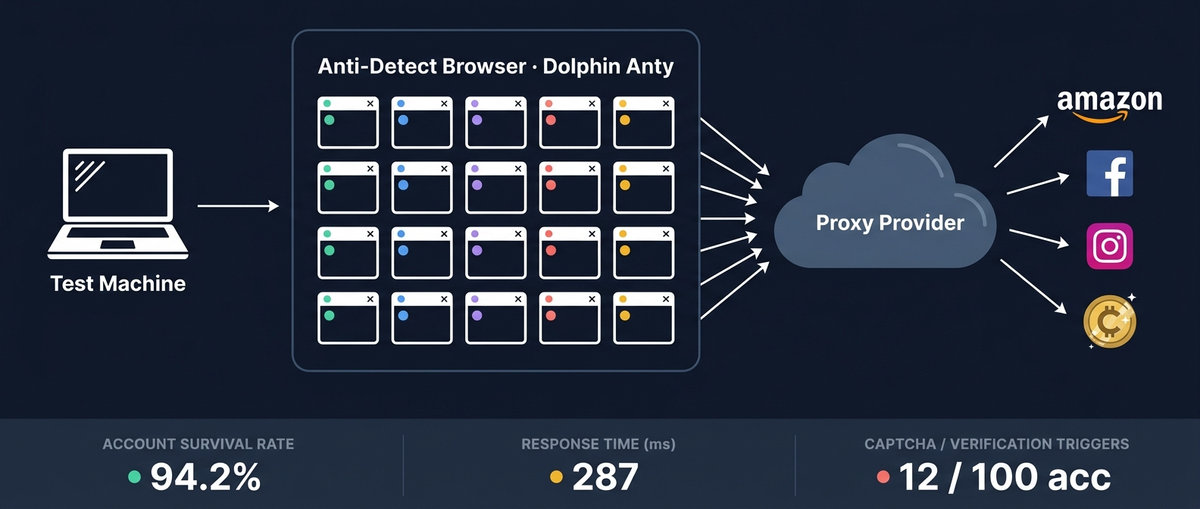
I’m not going to pretend we ran “extensive benchmarks across 47 parameters.” Here’s what we did.
We created 20 browser profiles in Dolphin Anty. Each profile got a unique fingerprint – different Canvas hash, different WebRTC config, different User-Agent, different timezone. We assigned one proxy per profile and registered accounts on Amazon, Facebook, Instagram, and a mid-tier crypto platform. Then we logged into each account daily for 30 days, doing normal activity: posting, browsing, making small purchases, running low-budget ad campaigns.
We tracked three things. First: did the account survive? Second: what was the average response time? Third: how often did we get hit with a CAPTCHA or verification request?
That’s it. Real accounts, real platforms, real consequences.
The 7 Providers, Ranked
| Rank | Provider | Score | Best For | Sticky Session | Pool Size | Price From |
|---|---|---|---|---|---|---|
| 1 | NodeMaven | 4.6 | Facebook Ads farms, Amazon sellers, crypto airdrops | Up to 7 days | 30M+ | $2.20/GB |
| 2 | Byteful | 4.3 | Best for: Mass account creation, bot automation, web scraping and data extraction pipelines | Unpredictable | 35M+ | $1.75/GB |
| 3 | FloppyData | 4.2 | SMM, affiliate marketing, budget multi-accounting | Up to 60 min | 65M+ | $1.00/GB |
| 4 | Mobileproxy | 4.4 | Instagram, TikTok, Facebook multi-accounting | Unlimited (private channel) | 170M+ | $5.90/day |
| 5 | IPRoyal | 4.0 | Beginners, sneaker bots, small account farms | Up to 24h | 64M+ | $1.75/GB |
| 6 | Proxy-Seller | 3.7 | Matched betting, gaming, long-term static accounts | Static (permanent) | 20M+ | $0.16/IP |
| 7 | MangoProxy | 4.0 | Crypto farming, token sales, ad verification | Up to 120 min | 90M+ | $0.99/GB |

NodeMaven filters IPs in real-time before assigning them. For multi-accounting this matters more than pool size: you get addresses that haven’t been burned by other users farming the same platforms you’re targeting.
Why it works for multi-accounting:
Each browser profile in Dolphin Anty or AdsPower needs an IP that looks like a real person’s home connection. NodeMaven’s IPs come back as genuine ISP addresses (VA SkyWire AS19919, Comcast, Verizon Fios) across every checker – IPinfo, IP2Location, BrowserLeaks. Sticky sessions hold up to 7 days, so your Amazon seller account or Facebook Ads profile sees the same IP on Monday, Wednesday, and Friday. ZIP-code targeting means account #1 sits in Houston 77001 and account #2 in Dallas 75201 – different cities, different subnets, zero overlap.
Pricing:
- Residential from $2.20/GB (pay-as-you-go ~$4.44/GB);
- Monthly plans from $35/month (~$3.80/GB);
- Trial: $3.50 for 750MB;
- Traffic rollover on all subscription plans.
Bottom line:
I ran 25+ proxies through FOGLDN checker – 100% success, zero failures. Scamalytics scored 0/100. No proxy detected on Pixelscan. For multi-accounting on Facebook, Amazon, or crypto platforms where one dirty IP kills your entire farm, NodeMaven’s pre-filtered pool is the safest option I’ve tested. Speed won’t impress you (9-10 Mbps), but for logging into accounts and managing profiles, you don’t need 50 Mbps.
- Fraud Score 0/100 on Scamalytics - platforms see a regular home user, not a proxy;
- Pixelscan returns 'no proxy detected' with consistent fingerprint - antidetect browsers pair perfectly;
- ZIP-code targeting across 150+ US locations so each account gets a geographically believable IP;
- Super Sticky sessions up to 7 days - same IP on every login, zero fingerprint drift;
- ASN/ISP filtering (T-Mobile, Comcast, Verizon) lets you match the IP provider to the account's profile;
- Traffic rollover on subscriptions - unused GB carry forward between billing cycles.
- Download speed 8.6-9.8 Mbps - fine for account work, too slow for scraping on the side;
- $3.80/GB on subscription is above market average;
- TCP/IP fingerprint reads Android while browser runs Windows - advanced anti-bot can catch this mismatch;
- No free plan, cheapest entry is $3.50 for 750MB trial;
- KYC required for full dashboard access.

Byteful (formerly Ping Proxies) earned Proxyway’s Newcomer of the Year 2026 with 81.23% success rate on hard targets – first place out of 13 providers. For multi-accounting, their standout feature is OS-level targeting: you can request proxies that match Windows, Android, or Linux at the TCP/IP stack level, which eliminates the fingerprint mismatch that advanced anti-bot systems use to link accounts.
Why it works for multi-accounting:
Mass account creation needs speed, API integration, and concurrency. Byteful connects in under 500ms with no cap on simultaneous sessions. The pool shows you exactly how many IPs exist in your target location before you generate credentials – so you know whether Houston has 12,000 addresses or 300 before you assign proxies to 50 browser profiles. Static residential IPs from US ISPs (Comcast, Spectrum, AT&T) are available for long-term account maintenance. But sticky session duration is unpredictable, so this is better for account creation and warm-up than daily management.
Pricing:
- Residential: $3.25/GB (10GB), $2.75/GB (100GB), from $1.75/GB at high volume;
- Static ISP from $3.50/IP/month;
- 1GB free trial (KYC required);
- 10% off quarterly, 20% off annual billing.
Bottom line:
If you’re spinning up 200 accounts over a weekend and need fast, clean IPs with zero blacklist history, Byteful delivers. FOGLDN returned 108-174 ms with zero errors. Scamalytics scored 11/100. The OS-targeting feature alone justifies the price for serious multi-accounters – no other provider on this list offers it. But don’t rely on it for daily account management: the sticky session inconsistency means your IP might change mid-session without warning.
- OS-level targeting (Windows, Android, Linux) in proxy generator - solves the TCP/IP fingerprint mismatch that gets accounts flagged;
- Fastest residential speed tested: 17.96 Mbps median, FOGLDN 108-174 ms response;
- Scamalytics 11/100, Pixelscan fingerprint consistent - safe for account registration on protected platforms;
- Blacklist score 0/45 on Pixelscan - none of the IPs were previously flagged;
- Pool indicator shows exact IP count for your targeting before you generate - you see how many clean addresses exist in your chosen city;
- 1GB free residential trial to test before committing real accounts;
- Traffic never expires.
- IP uniqueness only 44% on narrow targeting - if you're running 50 accounts in one city, you'll get duplicate addresses;
- Sticky sessions have no duration control - IPs rotated unpredictably during testing;
- KYC (passport or license) required even for the free trial;
- 24-hour refund window, once per lifetime;
- Support is weekdays only (5 AM-7 PM EST), no weekend coverage.

FloppyData’s rotating proxy bundles residential, mobile, and datacenter into one product at $1.00/GB. For multi-accounting on a budget, this means you can test which proxy type works best on your target platform without buying separate packages.
Why it works for multi-accounting:
The built-in site tester lets you check if an IP passes your target platform’s detection before you assign it to a browser profile. Generate a proxy, test it against Amazon or Facebook directly in the dashboard, and only then paste credentials into Incogniton or GoLogin. Static residential IPs at $1.79/month per IP with unlimited bandwidth are the cheapest option on this list for maintaining long-term accounts – assign one static IP per account and log in daily without worrying about traffic costs. Real Comcast hostnames (hsd1.tx.comcast.net) pass ISP verification checks on all major platforms.
Pricing:
- Rotating proxies: $1.00/GB on subscription, $1.50/GB pay-as-you-go;
- Static residential from $1.79/IP/month (unlimited bandwidth);
- Static datacenter from $0.79/IP/month (unlimited bandwidth);
- No free trial available.
Bottom line:
For affiliate marketers and SMM managers running 10-30 accounts on mid-tier platforms, FloppyData hits the price-quality sweet spot. Scamalytics 14/100, real Comcast AS7922 IPs, DNS leak-free on SOCKS5. The site tester feature alone saves you from assigning a dirty IP to an account you spent days warming up. But always use it inside an antidetect browser – Chrome leaks WebRTC IPv6, and that one leak can link all your profiles.
- $1/GB rotating proxies that include residential, mobile, AND datacenter - switch types mid-session without extra cost;
- Fraud Score 14/100 on Scamalytics, 0/79 detections on IPQS - clean enough for account registration on Facebook and Amazon;
- Real Comcast IPs (AS7922) with valid reverse DNS (hsd1.tx.comcast.net) - platforms see a genuine home connection;
- Built-in IP Rotation Checker and site tester in dashboard - verify an IP works on your target platform before assigning it to an account;
- SOCKS5 with FQDN resolving on proxy side - no DNS leaks to betray your real location;
- Static residential at $1.79/IP/month with unlimited bandwidth - cheapest long-term account maintenance option;
- 70+ crypto payment options.
- Latency spikes up to 8024 ms (1 in 20 requests) - an account login that hangs for 8 seconds looks suspicious;
- One proxy drop in 30 minutes of testing - session died and needed regeneration;
- WebRTC IPv6 leak in Chrome without an antidetect browser - must use Dolphin Anty or AdsPower;
- PAYG markup is +50% ($1.50/GB vs $1.00/GB on subscription);
- Weak coverage in Eastern Europe and Latin America outside Brazil;
- Past fake-reviews scandal on Trustpilot - do your own due diligence;
- No free trial.
MobileProxy.Space runs physical USB modems in server racks. Each client rents a dedicated port on a real device – no shared pools, no neighbors burning your reputation. For social media multi-accounting (Instagram, TikTok, Facebook), mobile IPs are the only type that platforms genuinely trust because CGNAT makes banning them impossible without blocking real phone users.
Why it works for multi-accounting:
Social media platforms fingerprint connection type. Instagram expects mobile carrier IPs from real 4G/5G networks, not residential broadband. When you run 12 Instagram accounts through MobileProxy inside AdsPower, each profile looks like a person scrolling on their phone. The carrier selection feature means account #1 connects through T-Mobile and account #2 through AT&T – different carriers, different subnets, zero correlation. Unlimited traffic means you don’t throttle usage when feeds autoplay video. The private channel guarantees nobody else’s automation has already flagged your IP address.
Pricing:
- CIS/Europe channels from $25-30/month;
- Tier-1 countries (USA, Australia) from $80-100+/month;
- Unlimited bandwidth on every plan;
- 2-hour free trial available.
Bottom line:
I stress-tested at 100 threads scraping Amazon through a Kazakhstan proxy. Speed dropped to 3 Mbps under load, but the modem held 250 simultaneous sessions without crashing. Scamalytics scored 1/100. For Instagram, TikTok, and Facebook multi-accounting where account survival depends on IP trust more than speed, this is the provider. Rotation is slow (10-15 seconds per modem reboot), so don’t use it for mass registration. Use it for maintaining high-value social media profiles that you can’t afford to lose.
- Private channel - you're the only user on your port, nobody else's spam burns your IP reputation;
- Scamalytics risk score 1/100 - the lowest mobile score we've tested, platforms see a legitimate phone user;
- Handled 250 simultaneous connections in ZennoPoster without dropping one - run your entire account farm through a single channel;
- Unlimited bandwidth on every plan - Instagram and TikTok autoload video constantly, per-GB billing would destroy your budget;
- CGNAT means thousands of real mobile users share your IP - platforms can't ban it without blocking real customers;
- Carrier selection (T-Mobile, Vodafone, AT&T, Megafon) so each account matches a believable mobile provider;
- 2-hour free trial, no credit card.
- Tier-1 countries (US, Australia) run $80-100+/month per channel;
- IP rotation takes 10-15 seconds (physical modem reboot) - can't rapid-fire rotate during mass registration;
- Speed fluctuates 3-30 Mbps depending on tower load, ping 230+ ms;
- Interface looks like 2012 - functional but not pretty;
- Only 40+ countries vs 195+ on residential providers - limited geo diversity for global account farms.

IPRoyal sources IPs through Pawns.app where real users sell bandwidth voluntarily. For multi-accounting beginners, the non-expiring traffic model removes the biggest pain point: you buy traffic once and use it at your own pace without watching a monthly timer.
Why it works for multi-accounting:
Starting a multi-accounting operation means experimenting. Testing which antidetect browser works for you, learning how many accounts one IP can handle, figuring out warm-up schedules. IPRoyal lets you buy 5GB, use 500MB this week testing setups in GoLogin, and come back next month with the remaining 4.5GB when you’re ready to scale. Sticky sessions hold 24 hours, so each account maintains its IP between daily logins. City-level targeting places each profile in a specific location. The flat-rate mobile proxies with unlimited bandwidth work for social media accounts where you want predictable costs.
Pricing:
- Residential: from $1.75/GB (bulk) to $7.00/GB (1GB);
- Mobile proxies: flat daily rate with unlimited bandwidth;
- Non-expiring traffic on all residential plans;
- No mandatory subscription.
Bottom line:
Support responded on December 31st in 20 minutes – that kind of reliability matters when an account gets flagged at midnight and you need fresh credentials fast. IP quality is a coin flip though: some sessions land on clean addresses, others hit Spamhaus-listed IPs. Always check your assigned IP through Scamalytics before logging into a valuable account. Best for beginners scaling gradually, sneaker bots, and small account farms where individual account value is moderate.
- Non-expiring traffic - buy 10GB, use 3GB this month, the rest waits indefinitely. No monthly reset pressuring you to waste bandwidth;
- Sticky sessions up to 24 hours - log into the same account from the same IP today and tomorrow;
- 24/7 support that actually works - solved a proxy issue in 20 minutes on New Year's Eve;
- Ethical IP sourcing through Pawns.app (real users voluntarily sharing bandwidth) - IPs carry genuine residential classification;
- Low entry barrier: start from 1 day or 1 GB with no subscription lock-in;
- City-level and ASN geo-targeting for placing each account in a believable location.
- Pool cleanliness is inconsistent - got IPs already on Spamhaus blacklists from previous users;
- iphey.com flagged some proxies as detected - risky for platforms with advanced anti-bot;
- Small-volume pricing is steep ($7/GB for 1GB) - you need to buy bulk to get competitive rates;
- Mobile proxy rotation takes 10-30 seconds during IP changes;
- Speed is unstable - not SLA-grade for enterprise account operations.

Proxy-Seller has operated since 2014 and specializes in static IP products. For multi-accounting workflows where you maintain the same accounts for months – matched betting profiles, gaming accounts, long-term e-commerce stores – their ISP proxies provide a permanent address that builds trust history with the platform over time.
Why it works for multi-accounting:
Some accounts need consistency, not rotation. A matched betting profile you’ve been warming up for 3 months can’t suddenly appear from a new IP – the bookmaker flags it instantly. Proxy-Seller’s ISP proxies assign one static IP per account, registered under a real Internet Service Provider, with datacenter speed and stability. Your account sees the same address every single login. The IPv6 datacenter tier at $0.16/IP is also uniquely useful: if your target platform accepts IPv6, you can assign a unique dedicated proxy to each account for practically nothing.
Pricing:
- Residential from $3.50/GB (pay-as-you-go);
- ISP from $3.00/IP/month;
- IPv4 datacenter from $0.70/IP;
- IPv6 datacenter from $0.16/IP;
- No mandatory subscription on any product.
Bottom line:
Scamalytics returned 0/100 and Whoer gave 100% masking – anonymity scores are excellent. But city-level targeting is broken for major regions (fields stay grayed out), which limits your ability to place accounts in specific locations. The DNS leak is a real problem for multi-accounting: if your account is supposed to be in Colombia but DNS resolves through US Google servers, a platform matching DNS location to IP location will catch the discrepancy. Best for static, long-term account management on platforms with moderate anti-fraud, not for fresh registrations on hardened targets.
- Fraud Score 0/100 on Scamalytics and Whoer 100% masking - the IP looks like an ordinary home user;
- ISP proxies give you a static IP that never changes - same address every login for months of consistent account history;
- IPv6 datacenter from $0.16/IP - cheapest option for platforms that accept IPv6 (gaming, some ad networks);
- Pixelscan returned 'Human Detected' on bot detection test;
- Five proxy types in one platform - residential, ISP, IPv4 DC, IPv6 DC, mobile;
- 24/7 live chat that actually responds at 2 AM;
- No mandatory subscription - pay-as-you-go on all products.
- City-level targeting grayed out for popular regions (US, Europe) - can't place accounts in specific cities;
- DNS leak: US Google servers visible while using a non-US IP - BrowserLeaks and IPLeak.net both caught it;
- Usage Type classified as Corporate/Business instead of Residential - advanced anti-bot flags this;
- IPs on 3-5 email spam blacklists (Spamhaus ZEN, DRONE BL);
- Residential pool is 20M+ IPs - smaller than every other provider on this list;
- High latency: 1412-2970 ms from various locations.

MangoProxy launched in 2023 and claims 90M+ residential IPs across 200+ locations. For multi-accounting at scale, their standout metric is IP uniqueness: 391 requests returned 391 completely unique addresses with zero duplicates. When you’re assigning proxies to 100 browser profiles, that guarantee of no address overlap is critical.
Why it works for multi-accounting:
The built-in proxy checker tests your IP against a specific URL before you assign it to an account. Generate a proxy, check it against facebook.com or amazon.com, confirm it passes, then paste credentials into Dolphin Anty or Octo Browser. ZIP-code and ASN targeting means account #1 gets a Comcast IP in Miami 33101 and account #2 gets an AT&T IP in Tampa 33601 – different providers, different cities, different subnets. The 100% IP uniqueness rate means you’ll never accidentally assign the same address to two different accounts in your farm.
Pricing:
- Residential: $3.30/GB (5GB), drops to $2.00/GB at 1TB;
- Residential Light: from $0.99/GB (smaller pool);
- Static ISP from $3.29/IP/month;
- Mobile from $9/day (unlimited traffic);
- Minimum entry: $16.50 for 5GB.
Bottom line:
Every IP came back as real Comcast AS7922 with valid Florida hostnames. DNS was spotless – all 22 resolvers routed through Comcast, no leaks. FOGLDN and Byteful tester both showed 100% success against google.com. But WebRTC leaks IPv6, which is a dealbreaker if your antidetect browser doesn’t explicitly patch it – that leaked address can link every account in your farm. Sticky sessions cap at 120 minutes, so for daily account management you’ll need to accept IP changes between sessions. Best for crypto airdrop farming, token sales, and ad verification where you need massive geo diversity and short-burst sessions rather than long-term profile maintenance.
- 391 unique IPs out of 391 requests - zero duplicates, meaning each account in your farm gets a genuinely distinct address;
- Real Comcast IPs (AS7922) with hsd1.fl.comcast.net hostname - platforms see a Florida home internet user;
- Fraud Score 15/100 Scamalytics, 0/79 detections on APIVoid - clean enough for account registration;
- DNS fully clean: all 22 resolvers inside Comcast network, no third-party leaks to betray your real GEO;
- Built-in proxy checker tests against your target URL before you assign the IP to an account;
- Country, state, city, ASN, ZIP targeting - place each account in a hyper-specific location;
- Crypto payments with no verification, 11+ currencies;
- Official integrations with Dolphin Anty, Undetectable, and Octo Browser.
- WebRTC leaks IPv6 - if your antidetect browser doesn't block this, platforms can link your accounts through the leaked address;
- Latency p50 780 ms, median 1115 ms - noticeably slow for daily account management;
- Sticky sessions max 120 minutes - too short for extended account work sessions;
- Stats and usage history vanish the moment your traffic hits zero;
- Refund policy is 'All sales are final unlike others that offer a strict money-back guarantee.' with a 48-hour window;
- Advertised $0.6/GB price is unreachable on normal packages - real entry is $3.30/GB;
- Trustpilot 3.5/5 with 66% negative reviews.
The Real Reason Accounts Get Banned (and How Proxies Fix It)
People think account bans are about behavior. Posting too fast, liking too many things, creating listings too quickly. And sure, behavioral triggers exist. But the vast majority of multi-accounting bans in 2026 happen at the infrastructure level, before you even do anything suspicious.
Here’s what platforms actually see.
Your IP address is the first checkpoint. Your IP address and MAC address are the first checkpoints. Two accounts from the same IP? Linked. Done. But modern detection goes further. WebRTC – the technology browsers use for real-time communication – can leak your real IP even when you’re behind a proxy, unless your antidetect browser explicitly blocks or spoofs it. Canvas fingerprinting renders invisible graphics through your GPU and creates a hash that’s unique to your hardware. Your User-Agent string broadcasts your browser version, operating system, and device type. Some platforms even check timezone and language settings against your IP’s geographic location.
One account logging in from a residential IP in Chicago with an English-language Chrome browser on Windows? Normal. That same IP suddenly appearing with a Portuguese-language Firefox on Linux? Red flag. An antidetect browser solves the fingerprint side – each browser profile generates its own Canvas hash, its own WebRTC response, its own User-Agent. The proxy solves the network side – each profile gets its own IP from its own location.
Residential vs. Mobile vs. Datacenter vs. ISP: A Blunt Assessment
Residential
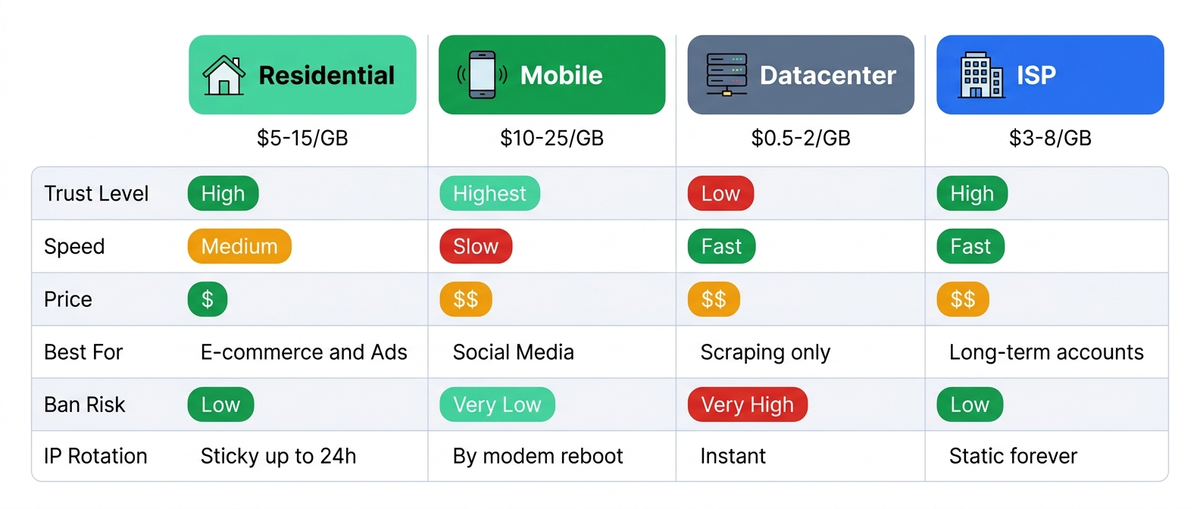
The workhorse. IPs from real home internet connections assigned by real ISPs. Websites see a Spectrum customer in Dallas or a BT subscriber in London. High trust, big pools, solid geo-targeting. This is what you use for Amazon, eBay, Facebook Ads, Google Ads, and most e-commerce.
The drawback is bandwidth cost. You pay per gigabyte, and heavy pages with images and scripts eat through traffic. A single Facebook session can burn 200-500MB if you’re scrolling feeds and loading ad dashboards.
Mobile
The most trusted and the most expensive. Carriers use CGNAT to share individual IPs across thousands of real phones. Instagram, TikTok, and Facebook know this. They won’t flag a mobile IP because doing so would block paying customers.
Mobile proxies are billed by time (per day, per week) rather than by data, with unlimited traffic. Speeds are slow (2-5 Mbps) because you’re going through an actual cellular network. Use them for social media exclusively. For anything else, you’re overpaying for trust you don’t need.
Datacenter
Fast. Cheap. Detected instantly on any platform with even basic anti-fraud. A datacenter IP screams “I am a server, not a person.” Amazon, Facebook, Google – they all flag these on sight. Don’t use datacenter proxies for multi-accounting on any protected platform. Period.
The one exception: account creation on low-security sites where speed matters more than stealth. Forums, small marketplaces, niche platforms with no real anti-bot system.
ISP (Static Residential)
The hybrid. An IP registered to a real ISP but hosted in a data center. Combines residential trust with datacenter speed and 99.9% uptime. The IP never changes – same address every login, every day, every month. This is what you want for long-term account maintenance: matched betting profiles, gaming accounts, e-commerce accounts you’ve been building for six months and can’t afford to lose.
More expensive per-IP than datacenter, cheaper per-GB than residential (because most ISP proxies include unlimited bandwidth). Proxy-Seller and NodeMaven both offer strong ISP products.
What Separates a Good Multi-Accounting Proxy from a Bad One
Session Persistence
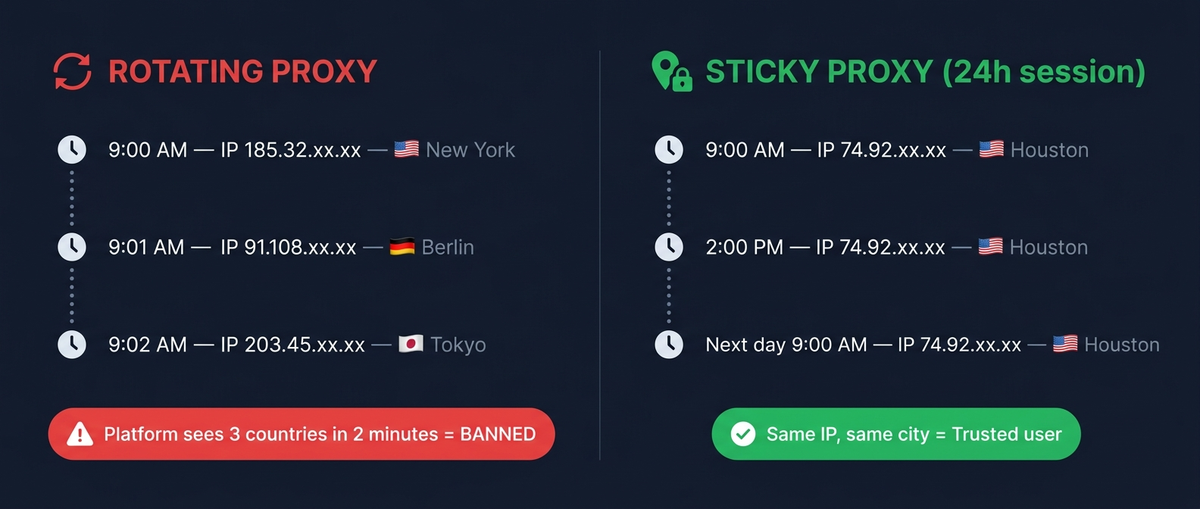
If your IP changes mid-session, the platform notices. For multi-accounting, you need sticky sessions – the same IP held for hours, ideally up to 24. Rotating proxies (new IP every request) are for scraping. Sticky proxies are for accounts. Don’t confuse these.
Pool Quality Over Pool Size
A provider with 10 million clean IPs beats one with 100 million dirty ones. Ask yourself: does the provider filter IPs before assigning them? Do they monitor blacklists? Or do they just throw you whatever’s available? NodeMaven filters in real-time. Most providers don’t.
Geo Granularity
Your proxy’s location needs to match your account’s story. A US Amazon seller account accessed from a Romanian IP will trigger review within days. Country-level targeting is the minimum. City-level is better. ASN targeting – where you choose which ISP the IP belongs to – is ideal for matching the specific network environment a platform expects.
SOCKS5 Over HTTP
Anti-detect browsers work with both, but SOCKS5 handles UDP traffic (needed for WebRTC spoofing), doesn’t rewrite packet headers, and operates at a lower network level. Every serious anti-detect setup I’ve seen defaults to SOCKS5 or highly secure HTTPS proxies. HTTP works for casual use. SOCKS5 is for when bans cost money.
Setting Up Proxies in an Anti-Detect Browser (3 Minutes)
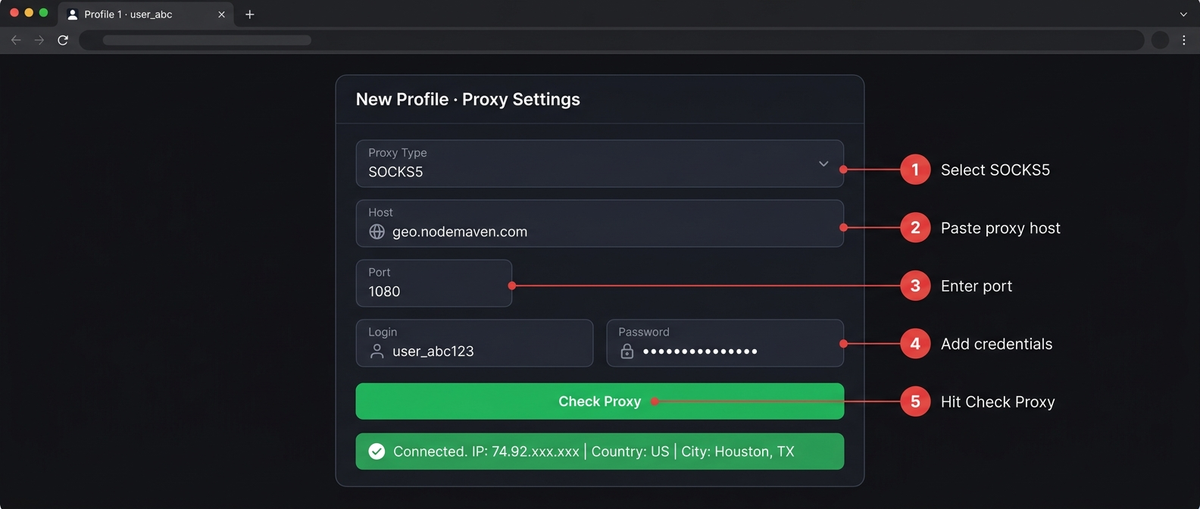
This works the same in Dolphin Anty, AdsPower, Multilogin, GoLogin, Incogniton, and Octo Browser. You won’t even need a separate proxy manager or proxy switcher extension. The button labels change, the process doesn’t.
- Create a profile. Each profile is a separate virtual browser with its own fingerprint. Set the operating system, screen resolution, timezone, and language to match the geo of the proxy you’ll assign. If your proxy is a US residential IP from Texas, set English language, Central timezone, 1920×1080 resolution.
- Enter proxy details. In the profile’s network settings, choose SOCKS5 (or HTTP if the provider doesn’t support SOCKS5 for your plan). Paste the connection string: IP:Port:Username:Password. Some providers also let you whitelist your own IP for passwordless authentication.
- Test. Hit “Check Proxy.” The browser pings the proxy and returns the detected IP, country, and city. Verify these match your intended geo. If the test fails, check your credentials, check that SOCKS5 vs HTTP matches what the provider assigned, and make sure your firewall isn’t blocking the port.
- Launch. Open the profile. You’re now browsing through a unique IP with a unique fingerprint. Log into your account. Repeat for every account in your farm.
NodeMaven and Byteful both have step-by-step integration guides for the major antidetect browsers. NodeMaven has official partnerships with Dolphin Anty and AdsPower, so the setup is even more streamlined – proxy credentials auto-populate in some cases.
FAQ
Can I use free proxies for multi-accounting?
I tried this in 2023 with a free proxy list from a popular aggregator site. Created 5 Facebook accounts through them. All 5 were disabled within 6 hours – before I even finished warming them up. Free proxies are recycled across thousands of users, blacklisted on every major platform, and some of them log your traffic. Not “some might log” – I ran a packet capture and watched unencrypted credentials pass through a “free SOCKS5” proxy in plaintext. Spend the $10. Please.
How many accounts per IP?
One. Always one. I know people who push 2-3 accounts per residential IP “because it’s from the same subnet and looks like a family household.” It works until it doesn’t. And when it doesn’t, you lose 2-3 accounts instead of 1. The only exception I’d make is mobile proxies, where the shared-IP nature of CGNAT makes 2-3 accounts per IP arguably more natural than 1. But even then, those accounts shouldn’t interact with each other.
VPN or proxy?
Proxy. A VPN routes ALL your system traffic through one IP – every tab, every app, everything. You can’t run 10 accounts simultaneously because they’d all share that single VPN address. A proxy is assigned per browser profile in your antidetect browser, so 10 profiles run 10 different IPs at the same time on the same machine. VPNs are for watching Netflix from another country. Proxies are for multi-accounting.
SOCKS5 or HTTP for antidetect browsers?
SOCKS5. It supports UDP (needed for proper WebRTC handling), doesn’t modify your request headers, and gives your antidetect browser full control over how traffic looks to the destination. HTTP proxies work for basic setups, but they inject proxy headers that some platforms can detect. Every provider on this list supports SOCKS5.
So Which One Do You Actually Buy?
Depends on what you’re protecting.
High-value accounts that cost real money to lose
Amazon sellers, Facebook Ads profiles with spend history, crypto wallets with airdrop eligibility. NodeMaven. The IP filtering is insurance, and 7-day sticky sessions mean your account sees the same address all week.
Social media farms on Instagram, TikTok, Facebook
Platform detection is specifically tuned to identify non-mobile traffic. Mobileproxy. Nothing else comes close on these platforms. Unlimited traffic means you’re not watching your bandwidth meter while feeds autoload video.
Just getting started with a tight budget
IPRoyal. Non-expiring traffic means you buy 5GB, experiment at your own pace, and nothing gets wasted while you learn.
Long-term accounts that need a permanent static IP
Matched betting profiles, gaming accounts, e-commerce stores you’ve been building for months. Proxy-Seller ISP proxies. One IP, one account, rock-solid stability for as long as you need it.
Mass account creation and automation pipelines
Byteful. No session caps, sub-500ms connections, unlimited concurrency. 1GB free to prove it works before you commit.
Cheapest per-GB proxy that actually functions
FloppyData at $1.00/GB for residential + mobile + datacenter combined. No frills. Gets the job done.
Crypto farming with massive geo diversity
MangoProxy with its 90M+ pool and ZIP-level targeting. 391 IPs tested, 391 unique. Zero duplicates.
Pick one. Test it on 5 accounts. Scale from there. The proxy is the foundation. Get that wrong, and no amount of fingerprint spoofing will save you.
Our top pick for most users: NodeMaven ($3.50 trial, 750MB). Cleanest pool we’ve tested, longest sticky sessions, works with every major antidetect browser out of the box.